Sunday, June 20, 2010

Make Homosexuals Marry. (Especially If One of Them Is Mike White.)

It actually makes me really happy that the (Pre-Kiss vs. Hug) Cameron & Mitchell Strategy I described earlier—more snappily dubbed "Make Homosexuals Marry" by those leading the charge—is being put to widespread use. Because long-term, life-melding commitment—especially marriage, regardless of gender—is known to have a negative effect on any couple's rampant fun & passion; it's actually counterproductive for those who fear The Big Bad Gay Lifestyle to oppose such unions between same sex couples. I mean, sure, it's a weird, roundabout way to make a point, but it definitely works for me—especially in this video. (Especially because I love Mike White.)

Today's Headphone Fodder:

Earlier tonight, I trekked up to the world's nosebleediest seats at Boston's House of Blues (seriously: back row, third floor of a very vertical venue) in order to see Evelyn Evelyn, the conjoined twin sister singer-songwriters who caused some internet brouhaha (sp?) with their potentially ableist backstory. After the main act (& a brief intermission), Jason Webley did a two-song "set," followed by Amanda Palmer, who performed some lengthy monologues on the State of Her Awesome Life / Being an Artist / Being Back in Boston, with the occasional musical interlude.

Though I was so not into the way Amanda handled a lot of the backlash against the Evelyns (regardless of the fact that some of the nay-saying could seem overreactive to those not feeling it for themselves), I actually did end up enjoying the twins' performance. The standout of the night was, of course, the song I'd seen live over two years ago, before this concept was actually a Thing, with conjoined dress et. al.: the song called You Only Want Me 'Cause You Want My Sister, which is infectious & clever & includes a Heathers reference. Also, they do a super-acoustic (that damn ukulele...) cover of Love Will Tear Us Apart—which, though one is like to cringe when looking through an ableist lens, is actually really great.

Still, I walked away from the night unsatisfied—more than just oxygen-deprived from the altitude: I wanted (want, will want; every tense) more Webley. That man is such a force of nature, brilliant songwriter, wildly talented performer—&, for the record, he was such a friggin' gentleman about the whole "Ableism Ableism" kerfuffle. I admire & adore him & his music to the utmost of utmosts, &, though I desperately wished for more, I was so very happy that he performed two of my favorites: There's Not a Step We Can Take That Does Not Bring Us Closer, with its customary violins vs. trombones audience standoff, & Last Song, which he dedicated to his recently deceased grandmother. (RIP, forever & on.)

There were, in fact, two more Webley songs performed later in the night: one, the fun-but-simple Drinking Song as a group encore; the other, a duet with Amanda of perhaps my very favorite (tied with those already mentioned—& Ways to Love. & Dance While the Sky Crashes Down. & Map. Eleven Saints. Days With You. This is a hopeless game.):


Yes, this is our big-text, official Song of the Day—mostly because I love it, a lot, but it's also catapulted above the rest because I'm a little peeved at how Amanda has so co-opted it. It's not that she ruins the song, per se; I suppose it does suit her theatricality & piano stylings. I just... It's Jason's song! & it's not like he's such a famous, established band as Radiohead; I really wish they could let the song get by on its own (read: his) merits. Now, it's nigh impossible to find a version of it that isn't somehow Palmerized.

Wednesday, June 16, 2010

A Struggle to Love My Hateful Neighbors.

[ NOTE: Upon waking, as so often happens when bile is spilt in print, I rethought a bit of what I had written here—but, rather than backtrack or edit that which had already been dealt, I decided to let this testament to my anger stand & simply reformed/clarified a bit of my argument in the comment section. So, just to make sure you get the full & measured weight of my opinion on the subject, you should read through to there. Many Thanks, The Management ]

So, here's the thing: I have a couple of posts in the works—some movie/TV ponderings, a tribute to David Cross, a review of the new Pernice Brothers album—but all of that has been put on hold in favor of this diatribe. I know it's not new—I know it's obvious to anyone who might actually be reading this now—but after encountering a particularly vile pocket of Christian hate speech on our beloved World Wide Web, I feel the need to contribute at least one small voice against the juggernaut, the minutest of slingshots against this unwieldy & fumbling Goliath, who manages to poison more minds than He will probably ever understand.


There is something fundamentally amiss, I feel, about calling these people (& their various counterparts, at varying degrees of severity—referred to en masse as the "Religious Right") Christian. Clearly, from the Jesus fish on their cars & the Bible quotes misspelled on their picket signs, we are meant to understand that they are admirers of Christ—but I refuse to call them his followers. After reading large swaths of the Bible this past fall, I learned several interesting things: that all of the Big Players (Noah, Abraham, etc.) apparently lived for multiple hundreds of years (seriously—look it up); that "Satan" was originally a name that simply meant "antagonist"—as in, the provocateur in the Book of Job, who is not necessarily the Prince of Darnkess; &, most importantly, that Jesus was, above all, a preacher of acceptance—the kind that trumps social strata & pre-assumed prejudice. Anyone—anyone—who would start a website called "GodHatesFags.com" has no business calling themselves a follower of Christ. It's just that simple.

I imagine that, if I posed this same thesis to any of the website's proprietors or supporters, I would receive a company line in the vein of we only hate people who hate God or we preach hate because the Bible preaches hate—to which I would respond, as I feel we all ought: BULLSHIT. Bullshit, utter & pure.

Look: the Bible is so, so very old—& has been translated & re-translated so, so many times—that it is, in fact, impossible to extrapolate the literal word of God from the literal words of the Bible. Anyone who claims that they can is just wrong; the very basis of Evangelicalism, certain other forms of Protestantism, Catholicism—the utter lunacy of "biblical inerrancy," that the Bible is infallible & divine—is actually just not possible at this point. Or, if you insist: this infallibility refers only to some ancient, molding text somewhere in Vatican City, written in Hebrew, NOT to the King James Bible in your motel room drawer or the Revolve magazine at your local Barnes & Noble. Because, as it stands today, the Bible just does not make sense as a document to guide modern human life, & therefore is in no way a valid justification for an attempt to marginalize an entire class of people.

This point was made far more snappily by Aaron Sorkin (filtered through the indignant & pointed bluster of Martin Sheen) in what will always be one of my very favorite episodes of The West Wing, which we will get to in due time—but, for now, let me just riddle you this: Do you believe that if a man sleeps with a woman who is a slave girl promised to another man but who has not been ransomed or given her freedom, there must be due punishment? Personally, I think that they are not to be put to death, because she had not been freed. Thank G-d, Leviticus 19:20 agrees!

Yes, gentle Reader, in the same chapter of the same book of the Bible that condemns homosexuality—or, well, the chapter right after it, as Leviticus 18 is essentially a long & detailed list of different kinds of incest—are the following decrees:


My point is not that Billy Ray Cyrus is responsible for the underage promiscuity epidemic (though those in charge of marketing his daughter are certainly not helping). Rather, my point is that half of these "decrees" are blatantly archaic, while the other half are being broken by phenomena such as celebrity fetishization & "pull yerselves up by yer own bootstraps" corporate greed—causes I have never seen a single letter-of-biblical-law church group take up with the same fervor as they do anti-gay rhetoric. The day I see a baptist minister railing against polyester blend shirts—or, for that matter, immigrant mistreatment—with the same venom as he devotes to gay people, I will at least be able to lower my wild cries of "HYPOCRITE" long enough to point out these two verses the hate-mongers have conveniently forgotten:

Do not go about spreading slander among your people. ... Do not hate your brother in your heart. (19:16-17)
Remember, this is in the same section of the Bible as the famous line that condemns homosexuality—& therefore deserves equal importance at least, or so I would think.

Still, if it came down to it, I imagine Pastor Fred Phelps & I would each ultimately wind up shouting at each other the second half of this more conciliatory verse, the half that groups like Westboro seem to hang their ever-weighty hat on: Rebuke your neighbor frankly so you will not share in his guilt. Judging by the number of their own rules these so-called Christians are clearly breaking—to love thy neighbor as thyself, among others—all in the name of the very shortest line in these two chapters, I think that I & many of my LGBT brethren have far more earned our right to rebuke—& rebuke we must.

As a firm believer in the First Amendment & all of its clauses, I would never support the banning of Baptist Christianity or its vile, vile websites. Ignorant people yelling hatefully is, unfortunately, one of the necessary evils inherent in real & present Free Speech. However, I absolutely believe, from the depths of my being, that we need to yell just as loudly back. For every sign that says "God Hates Fags" at the funeral of a fallen soldier, there need to be at least ten that say "God Hates Bigots." For every website that preaches ignorance & ill will, there needs to be a daily influx of negative comments, each brimming with the same vitriol these sites dole out. I am so very sick of liberals & LGBT organizations sitting back & doing damage control, while the Religious Right captures the eyes & ears of America simply because they are loud, inconsiderate assholes. Liberals need to start punching back against this hypocrisy, & soon.

So, with that: fuck off, Westboro Baptist Church—your supporters, your peers, all of you. Seriously. I hope you each endure serious, excruciating torture for all the pain you have caused, you rotten, rotten people.

I am so tired of turning the other cheek, of trying to respect your right to exist—when, in fact, those are supposed to be your values, ones that you somehow shucked off along with basic human compassion & any sense of decency. I will always speak loudly & wrathfully against you, so long as you are allowed to spew virulent hate speech against entire legions of people whom you have never met, who mean you no harm, & who, in fact, often do their best to tolerate you, even in the face of your blind & ill-informed intolerance of them. So, please, crawl back to your sterile, sexless prison of misconstrued "values" & arbitrary law, endlessly stabbing towards Meaning with only the blunt cudgel of "spirituality" & stale hatred at your disposal. You are cruel, & you are wrong, & your opponents will triumph.

All right, I've said my piece. Take it away, President Bartlet.


Today's Headphone Fodder:

To balance out the preceding heaviness & bile, here is something that actually, without fail, makes me weep with laughter: Kate Bush's Wuthering Heights (which, come on, is a pretty excellent song—or would be, if taken down an octave or three) synced, without any editing, to Zac Efron's Golf Course Dance of Angst & Defiance from High School Musical 2. It is a goddamn miracle how well—& hilariously—it matches up. Hallelujah.


(Here, too, is the James St. James post that led me to this masterpiece.)

Monday, June 14, 2010

I Am Okay With / Not Okay With...


& so begins what I assume will be a recurring post theme, as I often find myself thinking in such constructions: two pieces of pop culture debris tumble into my consciousness, both of which I'm a more than a little dubious about, & the veritable mail-sorter that is my brain (though, admitted, it's sometimes faulty) lets one slide through & forth to its intended, while the other is filed under Return to Sender, with hopes that it blow up royally in said individual's face upon arrival. So, without further ado, here are today's contenders:

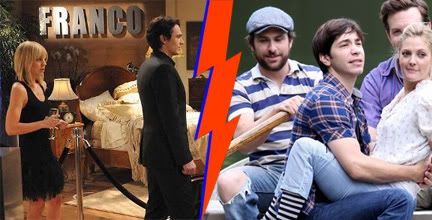
Charlie Day Becoming a Big-Screen Comedy Star.

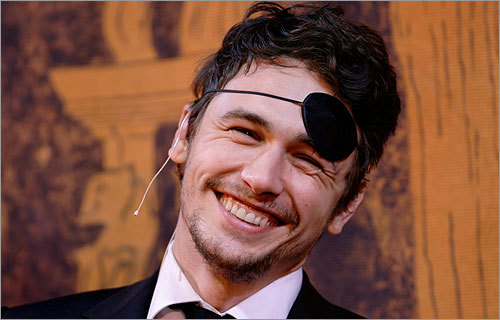
James Franco Becoming a Pretentious Douchebag.

I'm a huge fan of It's Always Sunny in Philadelphia, & Charlie is by far my favorite character, so I suppose I ought to applaud his continued success. However, it's in a really bland-looking Drew Barrymore romantic comedy—&, moreover, most successful mainstream comedians lead wildly depressing lives of artistic compromise & drug addiction, & I wouldn't wish that on anyone, especially someone who is truly talented. Meanwhile, though he is one of the more attractive humans to grace the planet (no, seriously: his smile chases away stormclouds), James Franco has officially renounced the world of cinema in favor of masturbation ironic/postmodern performance art, by designing his own recurring role on the soap opera General Hospital. While this means that we are safe from another Franco butchering of beloved Beat icons (or, Tristan & Isolde 2: People Looking Even Sexier On a Beach), it also means that he will be smarming & winking all over Freshmen girls in the Columbia library again this year—&, even worse, that we are forced to put up with his ridiculous notion that he is an artiste, with an "e" & a beret & a fuckload of undeserved 'tude.

Though there was likely little mystery to this one, let's see our final results.

I Am Okay With: Charlie getting big parts for big bucks.

At least for now. The moment I see the straight-to-DVD Santa Clause 4: All Elf Breaks Loose in my local CVS, with Charlie cast as Santa's most cantankerous workman, I'm personally pulling the plug on this thing. But today, I tend to take same position as the folks in this Entertainment Weekly article (I know, ick, but they make a valid point): that Charlie Day is awesome—not only because he is hilarious, but because, though his Sunny character is at times repulsive, insane, & wildly stupid, he is always eminently lovable, which is a serious performative feat. I agree, too, that I'd be interested to see what he does with a more dramatic (or, at least, less regressed) role; I think my vote may change on this one if he's continually typecast, doomed to play various iterations of his first successful character until the day he fades from the screen (see: Michael Cera, Jack Black, Adam Sandler, on & on). So, with fingers crossed, I will tolerate this upcoming Drew Barrymore/Justin Long "HEY AMERICA, WE'RE FAMOUS & WE'RE GOING OUT" showcase—or, more accurately, I will tolerate Day's role in it. & I may even tolerate this "Horrible Bosses" movie if it ever actually comes to fruition, especially because Michael Bluth ought to have far more work than he does.

Now, because we're thinking positive (/ as a buffer against the vitriol that threatens to spew forth in the next section), here are some of my favorite television moments ever, ever:

[ NOTE: Of course, my very favorite one—from the musical episode, in which Charlie repeatedly asks Dennis to "take a five"—is nowhere to be found online. Ah, the best laid plans... ]


I Am Not Okay With: what a complete & total asswipe James Franco has turned out to be.


"You got a very special interview... Yeah, you got a very special interview."

Oh, put the camera down, you walking midlife crisis beacon. Not only do I rarely tolerate your chosen crossover medium (& I have a hilarious David Sedaris story to back me up), but your particular brand of "I'm an artist now" elitism—the manufactured veil of obscurity over these projects, as if anyone would ever think they were important—is one of the things that pisses me off so eternally about such insular, hyper-"intellectual" pursuits, because they will forever cast a shadow on creative types & often scare people away from modern art. I mean, clearly I'm just too unenlightened, too entrenched in the hoi polloi to view you as anything other than an utter hack & dilettante; my supreme dislike must have nothing to do with the fact that art ought to unite people—ought to stir them, change them—not make them wonder why such a rich, famous man is stooping to the level of (gasp!) daytime television.

Is there anyone else who finds it so wildly up-his-own-ass masturbatory that this "art" is centered around ironic placement of his own famous face? I remember laughing out loud when I read the Wall Street Journal article—entitled "A Star, a Soap, & the Meaning of Art" (I shit you not)—in which he explains that by being on General Hospital ironically, he is actually trying to make people respect the medium he was de facto insulting. In his own words:

I disrupted the audience's suspension of disbelief, because no matter how far I got into the character, I was going to be perceived as something that doesn't belong to the incredibly stylized world of soap operas. Everyone watching would see an actor they recognized, a real person in a made-up world. My hope was for people to ask themselves if soap operas are really that far from entertainment that is considered critically legitimate. Whether they did was out of my hands.
Poor, tortured performance artist, ever misunderstood! In all your artistically significant questioning, did you perhaps stop to question that the very conceit of your project assumes soap operas to be unworthy of your time—so much so that you recognize the debasement involved in appearing on one with your (self-proclaimed) eminently recognizable face? I'm amazed that they were willing to have you at all, seeing as the very point of your presence was to highlight their perceived worthlessness—even as you claim to be somehow subverting it.

Later in the article, Franco ("just Franco") describes a current performance artist whose work consists of making "ecologically productive front lawns." Apparently, in a presentation at Columbia this past November (oops: missed that one), this artist said—while exchanging Oh Captain, My Captain glances with his new prodigy, I imagine—"Being an artist is the one profession where you can wake up and say, 'What do I want to learn about and participate in today?'" to which our Green Goblin wonders, "What could be more fun than that?"

The answer is, of course, nothing. If I were able to choose my profession, from all of those in the world, it would not be music video director, screenwriter, author, graphic designer, movie critic, actress—or even performance artist—but rather a wealthy celebrity with the liberty to dabble in all of these. & this is what I think is most lacking in Mr. Franco's evaluation of his own "work": recognition of the immense privilege that allows him to pursue it. (Which is especially ironic, because that's all performance art is ever about—questioning, ever questioning, its own circumstances.)

Also, I think it's important to note that as an artist of this kind, "learning" & "participating" come with a pre-applied sheen of non-participation, of irony—the kind that I find really, strongly distasteful. In the minds of these men, the tackiness of soap opera rolls off Franco's back like rain off a hermetically sealed duck, because he's not actually a soap opera actor—just as the man who so inspired him is not actually a landscaper. What they're doing is so much more significant than these lowly professions, can't you see? They're commenting on them.

Though I'm a massive advocate of media that questions itself—metafilm, metaficiton—I feel like things start to go downhill when there is more questioning going on than media-ing. Though I could regale you with the meta implications of Pale Fire from dawn to dusk, it is, first & foremost, a truly beautiful piece of fiction—just as Living in Oblivion, Adaptaion, & The Prestige are truly good movies—of which self-reference happens to be a part. Much like aleatory Dadist poetry, composed of nonsensical sounds & syllables, performance art tends to be the distillation of self-reflexivity, without much further content; it will seem stupid or insane, will be fundamentally un-entertaining until you read the program (or, the Wall Street Journal article) & thereby key into what you're supposed to be seeing. I will be the first to applaud a piece of theater that confronts its audience—even one that leaves some of its implications unclear—but I do demand that there be something there outside of comment-for-comments'-sake, & performing real-life actions ironically is something I really can't get behind. Take, for example, the opening of the article:

I was recently treated to an early prototype of a dessert that Marina Abramović, the "grandmother of performance art," created with the pastry chef Dominique Ansel. It's a cylindrical pastry with a lychee center sprinkled over with chili powder and raw gold. I was instructed to kiss a napkin that had been printed with a square of gold powder that would transfer to my face before eating the dessert. This way the dessert would pass through a golden gateway before it was ingested. I did as told, then suggested to the chef that it needed more chili. Was this art?
No, James Franco, that was you being a douchebag to a chef.


Today's Headphone Fodder:


Paris—Hans Unstern.

My parents recently returned from their Barcelona/Berlin honeymoon baring gifts, which meant for me a pin guaranteeing lifetime free admittance to the Ramones Museum, a necklace made of zippers, & a copy of Spex, a German pop culture magazine that includes a CD with every issue. From the latter in this list of wonder, I've extracted the above track, Paris—which is, German or no, pretty much an ideal song as far as I'm concerned. I love the doubled vocals, the monotone-until-it's-not, the surges, the carnival noises, the serious alliteration, the wordplay (which you can still kind of pick up on, I think, even without German)—the lyrics overall, which are often particularly beautiful. Though I don't feel confident enough (in my translation abilities / that you care to know) to translate the whole song, I'll at least give you the first few lines as best I can:
When will I learn that night can paint no shadows without a moon?

(Period, period, comma, dash, end.)
& when will I see a face that no longer reminds me of you?

When? Hours-, days-, years-long?

Thursday, June 10, 2010

55 Covers. (Never Say I Don't Love You.)


Okay. So. At one point—blathering on about Gaga, I believe—I mentioned briefly my intense affinity for covers. Now, having recently received Guilt By Association from my stepsister, I feel the need to revisit the subject—& to share, with whomever will listen, some really fucking excellent songs. 55 of them, to be exact—because apparently my secret X-men superpower is to accidentally choose nicely-rounded amounts. (Truthfully, I think I went a little overboard: So. Much. Linking. My. Dear. Jesus.)


[ NOTE: The format goes, "Song Title—Artist Doing the Covering (Artist Being Covered)." ]

* * * * *

[ EDIT: Oops—it's actually the band that Butler formed when the Furs were on hiatus. Apologies. ]

Covers can be tricky sometimes. I say this because nothing (repeat: nothing) could replace the floating, goosebumped feeling I got when I first heard the real “How Soon Is Now?”—& get, in lite version, each time since. That said, I’m a sucker for Richard Butler’s nasal rasp-drawl, & an honest-to-goodness rock surge with the first chorus does sound damn good. So I suppose it’s like children—love them equally, but differently.


In fact, maybe one of the best things about covers is this dual understanding—being able to at once appreciate the two parallel tracks of original & interpretation. For example, this song is just so deliciously different from the Stooges version, while simultaneously earning its own merit with those odd industrial clangs under wispy French vocals.

* * * * * *


There are, of course, many genres of covers. One of the most common in today's irony-ridden pop climate is the Guilty Pleasure cover (or, in more negatively-tinged cases, the Isn't It Funny How I Dug This Piece Of Obscurity Out of the 80s' Asscrack & Am Now Playing It Acoustically cover). Of course, these sorts of covers work best (or, at all) when both artist & listener share a genuine—if shame-ridden—like for the song. I mean, really: let's not pretend I don't know every damn word to Say My Name. Here are some more to tickle your fancy:


[ This one is VERY guilty—& also very good. ]

* * * * * *


Then come my personal favorites (when done well, that is): the Is That Even the Same Song? covers, versions that really rework the original, altering its gist significantly (e.g., changing the genre, the tempo, the gender of the singer). Average rock songs become either slow-acoustic or the heaviest of metal; techno turns to violins, guitar-wanking to disco beats—&, when you're lucky, it all works out beautifully.


* * * * * *


Most covers, of course, don't quite fit into either of the above categories: a respectable song that the artist actually likes, interpreted in a way that doesn't necessarily shift the song on its axis. & yet—& yet—they are still Just Plain Good:


Apologies for the songs that only link to a clip. (There should only be two or three; I was very thorough...) & as for the customary closing mp3: I politely refuse.

BUT: if you have any covers that you think I ought to hear, I'd love to. Though this clearly isn't my full stash, I know there are still many out there I have yet to experience—so, comment away!

Wednesday, June 9, 2010

Anneliese Watches Wolfman; Proclaims, "Darling, This Is No Joke..."


I first saw The Wolfman advertised in the space above my local subway entrance—where it stayed, for several months (before losing out to a Spanish language ad for a dating service), which means I was reminded of the impending film almost every day for a good while. In that time, I was able to hype myself up pretty sufficiently for a Monster Movie starring Benicio del Toro, Anthony Hopkins, & (especially) Hugo Weaving—a movie whose trailer promised the same Medical Mystery Period Piece feel as The Elephant Man, but with far more gut-ripping & gore.


Though the film quickly sank without a trace (it merits a measley 33% on Rotten Tomatoes), my brother & I managed to stumble upon it while hunting for a movie to snark at on a Tuesday night; I convinced him to give it a go, at least for curiosity's sake. After just under two hours spent repeatedly fighting off sleep, I reluctantly arose with a lurch of annoyance & some unanswered questions:

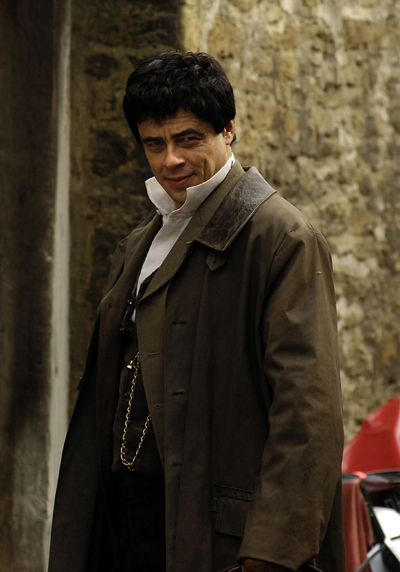
1) When exactly did Benicio del Toro get so unattractive? (Seriously, though: ouch.)

2) Why was he in this movie at all, as he ended up being the only person in England with an American accent? (&, moreover, as he got his ass handed to him performance-wise by Hugo Weaving—which was particularly funny because his character was supposed to be a renowned Shakespearean actor.)

3) Why, when the credits began to roll, did I see names like Danny Elfman—who has a hand in everything I love, from Oingo Boingo to singing for Jack Skellington to the instrumentals in Chicago—& Andrew Kevin Walker, writer of Se7en & serious, though uncredited, contributor to Fight Club (see: Detectives Andrew, Kevin, & Walker)??????

Rather than rejoice in recognizing former heroes, I felt betrayed, bewildered: how, in the name of all that is hol(l)y(wood), could these people have made such an oozing, putrid eyesore of a movie? No, seriously. How?! I am still baffled. Not only was the plot lagging, there was no plot; not one character merited an ounce of sympathy, nor had anything resembling a personality; there wasn't nearly enough campy, call-back material to attribute its shitty effects & gross-out gore to homage—all-in-all, just one of those dumbfoundingly dreadful movies that, though they look expensive & ought to be a good time, are actually physically unpleasant to watch. (The Black Dahlia, anyone?)

Mainly, though, I'm upset that there was no second layer to this concept—quite literally nothing beyond "ZOMG HE TURNS INTO A WOLF, GUYZ," on any level. While Christopher Nolan spent the better part of two & a half hours hammering the Dark & Deeply Ethical Symbolism of Batman into our heads (& was rightly lauded all the more for it), this movie—which only by its very last line manages to wonder "where [man] ends & [beast] begins" in wispy Victorian—delves not one whit beyond those words into the near-unavoidable metaphors inherent in the werewolf myth. Honestly, failing to make a werewolf metaphorically significant is harder than hitting the apple off William Tell's head—& yet, this movie manages to aim dead center.

But really now: the concept of werewolves has trickled down all the way from the Bible, &/or Ovid's Metamorphoses, both of which contain stories of a greedy, evil king (Nebuchadnezzar &/or Lycaön) cursed by God &/or Zeus to live as a wolf. In the case of Ovid, it's made especially clear that the form of a wolf is far more fitting than that of a man to Lycaön's brutal nature; even from its origins, even before werefolk sprouted fur & went wild only one night a month, it was important—was ingrained—that the werewolf revealed the dark nature of a man. Especially in its modernized idiom, when the gore is confined to a night of particular lunacy & the werewolf necessarily exists as both man & beast, it is, in my mind, wildly irresponsible to make a movie on the subject with no mention of this symbolism: no use of twinning or a "darker half," no emphasis on man's inherent wildness coupled with especially—even sartorially—repressive Victorian England.

There is a reason myths exist—why (for a disappointing dearth of one sentence in two hours) del Toro mentions Jack the Ripper. A man who uncontrollably morphs into a bloodthirsty wolf—much like the good doctor whose violent alter ego breaks out of the shadows—represents the literalizing of a very human fear: that Something Wicked lurks inside us & that somehow, the beast will out, flying our dirty secrets & unacceptable desires for all to see. I've previously explored the more benign aspect of this with Miike Snow's "Animal," but I think the Victorian Era—home to Jack & Jekyll & The Elephant Man himself—deserves a more extreme take.

As science reigned post-1850, asylums were seriously reformed: the notion that mental illness was a "disease of the soul" became passé, & doctors opted for scientific study of patients in lieu of neglect & feral treatment. Once something leaves appropriate public perception, though, it's doomed to be hashed & rehashed by pulp writers, leaking into urban myth & individual conscience; the widespread notion that mental illness can be scientifically explained only begs the question—in great, looming Scooby-Doo letters—But What If It Can't? For example, in this film's perhaps one decent scene, a doctor offers our protagonist a traditional psychiatric diagnosis of Lycanthropy (i.e., del Toro's character hates his father so much he has monsterized him, & himself by extension)—while the patient denies it, pleads for death, & ultimately literally lycanthrop-ifies behind him, soon skewering said doctor on a fence several stories below. In a society obsessed with mental illness—whose streets were haunted by slaughtered prostitutes, whose hospitals held a man deformed beyond the point of recognition—it follows that the chief villain to arise would be a man entirely out of control of his own humanity, a lawless creature slaked only with bloodlust & moonlight.

All of that said—& I do love to say it—the movie evokes none of this. Rather, it's a long collection of cheesy special effects & pointless non-twists, empty lines acted emptily with no sense of build-up or direction—& moreover, the actual werewolf, post-transformation, is laughably stupid-looking. There is, quite literally, nothing to get behind in this movie—except, perhaps, a rousing chorus of "Werewolves of London" with friends during the straight-from-a-videogame urban chase scene. Really, though: it's stunningly lifeless in every possible way.

However, this trainwreck of trainwrecks may ultimately not have been the fault of my main men behind the camera; as (my favorite) independent online film critic Dustin Putman explains in his review:
As so often seems to happen with big-budget, studio-bred Hollywood moviemaking, too many cooks in the kitchen have ruined what probably once started with the purest of intentions. Before several directors were shuffled in and out, multiple crew members quit, reshoots took place, release dates were scheduled and canceled, the composer was replaced before getting invited back at the last minute, and a war over final cut was waged, "The Wolfman" was intended as a loving tribute to the classic Universal monster movies of the 1930s and '40s, most notably 1941's original "The Wolf Man" starring Lon Chaney. As a loose remake, this update sports a prestigious cast and the kind of production design, art direction, cinematography, and costuming every bit as sumptuous as an $85-million budget can buy. What it lacks is not only a beating heart, but a beating anything.
Thank you, Dustin. As usual, you speak the truth.

[ My actual copy of Ovid's Metamorphoses. Clearly putting that education to good use, yessiree. ]

Today's Headphone Fodder:


I've been meaning to check out Placebo for a few years now, having known them only as That Band That Does a Kickass Cover of 20 Century Boy in Velvet Goldmine—& I finally did! Hooray for follow-through!

The results, while not so excellent as I would have originally thought, are still perfectly positive. I'm surprised at how... well... Emo they are: Post-Smashing Pumpkins Nasal-itude, Black Clothes & Nails, 30 Seconds to Mars-esque (But With Actual Musical Ability). The worst of it tends towards the recent, though; the first few albums (Placebo, Without You I'm Nothing, Black Market Music) have some gems, including Nancy Boy, which is deliciously coy & biting & all; Pure Morning , which is so catchy it ought to be banned in the 48 states at least; Special K , which is about exactly what you think (unless you're thinking of the breakfast cereal); Commercial for Levi , the lullaby-gone-wrong, which is short & sickly sweet in a perfect sort of way.

Aside from these few, though, my favorite of Placebo—so far, at least—is in the covers: the afore-linked T. Rex homage; androgynously gorgeous frontman Brian Molko's cover of Bowie's Five Years ; & this surprisingly moving (or is that really just me?), sonically-fleshed live version of the Pixies' Where Is My Mind , featuring an aged Frank Black. As Molko himself rhetorically closes: "Mais quelle dernière chanson, eh?"

EDIT: OH MY GOD YES PLEASE. (If you're not convinced right away, just wait around until after the first chorus. Brian Molko makes a really fucking excellent post-90s Morrissey-reinterpreter.)

Tuesday, June 8, 2010

"But if you listen, you'll learn to hear the difference..."


Why—though no one has ever actually asked me to do so—I will always side with Brian over Amanda.


Today's Headphone Fodder:


Half Jack—The Dresden Dolls.

Nostalgia; little pangs for what was. For them & for me: this song means driving in my grandparents' car, eons ago, lying down across the back seat & watching as the telephone wires squiggled & blipped against a bright blue sky.