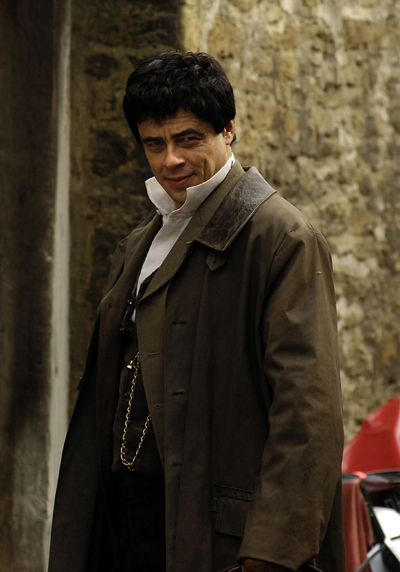
I first saw The Wolfman advertised in the space above my local subway entrance—where it stayed, for several months (before losing out to a Spanish language ad for a dating service), which means I was reminded of the impending film almost every day for a good while. In that time, I was able to hype myself up pretty sufficiently for a Monster Movie starring Benicio del Toro, Anthony Hopkins, & (especially) Hugo Weaving—a movie whose trailer promised the same Medical Mystery Period Piece feel as The Elephant Man, but with far more gut-ripping & gore.
Though the film quickly sank without a trace (it merits a measley 33% on Rotten Tomatoes), my brother & I managed to stumble upon it while hunting for a movie to snark at on a Tuesday night; I convinced him to give it a go, at least for curiosity's sake. After just under two hours spent repeatedly fighting off sleep, I reluctantly arose with a lurch of annoyance & some unanswered questions:
2) Why was he in this movie at all, as he ended up being the only person in England with an American accent? (&, moreover, as he got his ass handed to him performance-wise by Hugo Weaving—which was particularly funny because his character was supposed to be a renowned Shakespearean actor.)
3) Why, when the credits began to roll, did I see names like Danny Elfman—who has a hand in everything I love, from Oingo Boingo to singing for Jack Skellington to the instrumentals in Chicago—& Andrew Kevin Walker, writer of Se7en & serious, though uncredited, contributor to Fight Club (see: Detectives Andrew, Kevin, & Walker)??????
Rather than rejoice in recognizing former heroes, I felt betrayed, bewildered: how, in the name of all that is hol(l)y(wood), could these people have made such an oozing, putrid eyesore of a movie? No, seriously. How?! I am still baffled. Not only was the plot lagging, there was no plot; not one character merited an ounce of sympathy, nor had anything resembling a personality; there wasn't nearly enough campy, call-back material to attribute its shitty effects & gross-out gore to homage—all-in-all, just one of those dumbfoundingly dreadful movies that, though they look expensive & ought to be a good time, are actually physically unpleasant to watch. (The Black Dahlia, anyone?)
Mainly, though, I'm upset that there was no second layer to this concept—quite literally nothing beyond "ZOMG HE TURNS INTO A WOLF, GUYZ," on any level. While Christopher Nolan spent the better part of two & a half hours hammering the Dark & Deeply Ethical Symbolism of Batman into our heads (& was rightly lauded all the more for it), this movie—which only by its very last line manages to wonder "where [man] ends & [beast] begins" in wispy Victorian—delves not one whit beyond those words into the near-unavoidable metaphors inherent in the werewolf myth. Honestly, failing to make a werewolf metaphorically significant is harder than hitting the apple off William Tell's head—& yet, this movie manages to aim dead center.
But really now: the concept of werewolves has trickled down all the way from the Bible, &/or Ovid's Metamorphoses, both of which contain stories of a greedy, evil king (Nebuchadnezzar &/or Lycaön) cursed by God &/or Zeus to live as a wolf. In the case of Ovid, it's made especially clear that the form of a wolf is far more fitting than that of a man to Lycaön's brutal nature; even from its origins, even before werefolk sprouted fur & went wild only one night a month, it was important—was ingrained—that the werewolf revealed the dark nature of a man. Especially in its modernized idiom, when the gore is confined to a night of particular lunacy & the werewolf necessarily exists as both man & beast, it is, in my mind, wildly irresponsible to make a movie on the subject with no mention of this symbolism: no use of twinning or a "darker half," no emphasis on man's inherent wildness coupled with especially—even sartorially—repressive Victorian England.
There is a reason myths exist—why (for a disappointing dearth of one sentence in two hours) del Toro mentions Jack the Ripper. A man who uncontrollably morphs into a bloodthirsty wolf—much like the good doctor whose violent alter ego breaks out of the shadows—represents the literalizing of a very human fear: that Something Wicked lurks inside us & that somehow, the beast will out, flying our dirty secrets & unacceptable desires for all to see. I've previously explored the more benign aspect of this with Miike Snow's "Animal," but I think the Victorian Era—home to Jack & Jekyll & The Elephant Man himself—deserves a more extreme take.
As science reigned post-1850, asylums were seriously reformed: the notion that mental illness was a "disease of the soul" became passé, & doctors opted for scientific study of patients in lieu of neglect & feral treatment. Once something leaves appropriate public perception, though, it's doomed to be hashed & rehashed by pulp writers, leaking into urban myth & individual conscience; the widespread notion that mental illness can be scientifically explained only begs the question—in great, looming Scooby-Doo letters—But What If It Can't? For example, in this film's perhaps one decent scene, a doctor offers our protagonist a traditional psychiatric diagnosis of Lycanthropy (i.e., del Toro's character hates his father so much he has monsterized him, & himself by extension)—while the patient denies it, pleads for death, & ultimately literally lycanthrop-ifies behind him, soon skewering said doctor on a fence several stories below. In a society obsessed with mental illness—whose streets were haunted by slaughtered prostitutes, whose hospitals held a man deformed beyond the point of recognition—it follows that the chief villain to arise would be a man entirely out of control of his own humanity, a lawless creature slaked only with bloodlust & moonlight.
All of that said—& I do love to say it—the movie evokes none of this. Rather, it's a long collection of cheesy special effects & pointless non-twists, empty lines acted emptily with no sense of build-up or direction—& moreover, the actual werewolf, post-transformation, is laughably stupid-looking. There is, quite literally, nothing to get behind in this movie—except, perhaps, a rousing chorus of "Werewolves of London" with friends during the straight-from-a-videogame urban chase scene. Really, though: it's stunningly lifeless in every possible way.
However, this trainwreck of trainwrecks may ultimately not have been the fault of my main men behind the camera; as (my favorite) independent online film critic Dustin Putman explains in his review:
As so often seems to happen with big-budget, studio-bred Hollywood moviemaking, too many cooks in the kitchen have ruined what probably once started with the purest of intentions. Before several directors were shuffled in and out, multiple crew members quit, reshoots took place, release dates were scheduled and canceled, the composer was replaced before getting invited back at the last minute, and a war over final cut was waged, "The Wolfman" was intended as a loving tribute to the classic Universal monster movies of the 1930s and '40s, most notably 1941's original "The Wolf Man" starring Lon Chaney. As a loose remake, this update sports a prestigious cast and the kind of production design, art direction, cinematography, and costuming every bit as sumptuous as an $85-million budget can buy. What it lacks is not only a beating heart, but a beating anything.
Thank you, Dustin. As usual, you speak the truth.

[ My actual copy of Ovid's Metamorphoses. Clearly putting that education to good use, yessiree. ]
Today's Headphone Fodder:
I've been meaning to check out Placebo for a few years now, having known them only as That Band That Does a Kickass Cover of 20 Century Boy in Velvet Goldmine—& I finally did! Hooray for follow-through!
The results, while not so excellent as I would have originally thought, are still perfectly positive. I'm surprised at how... well... Emo they are: Post-Smashing Pumpkins Nasal-itude, Black Clothes & Nails, 30 Seconds to Mars-esque (But With Actual Musical Ability). The worst of it tends towards the recent, though; the first few albums (Placebo, Without You I'm Nothing, Black Market Music) have some gems, including Nancy Boy, which is deliciously coy & biting & all; Pure Morning , which is so catchy it ought to be banned in the 48 states at least; Special K , which is about exactly what you think (unless you're thinking of the breakfast cereal); Commercial for Levi , the lullaby-gone-wrong, which is short & sickly sweet in a perfect sort of way.
Aside from these few, though, my favorite of Placebo—so far, at least—is in the covers: the afore-linked T. Rex homage; androgynously gorgeous frontman Brian Molko's cover of Bowie's Five Years ; & this surprisingly moving (or is that really just me?), sonically-fleshed live version of the Pixies' Where Is My Mind , featuring an aged Frank Black. As Molko himself rhetorically closes: "Mais quelle dernière chanson, eh?"
EDIT: OH MY GOD YES PLEASE. (If you're not convinced right away, just wait around until after the first chorus. Brian Molko makes a really fucking excellent post-90s Morrissey-reinterpreter.)