Showing posts with label Film Major. Show all posts

Thursday, March 7, 2013

Sometimes It Pays to Do Your Homework.

As anyone connected to me via social media / telephone lines / bleary library eye contact is already well aware, I spent the better part of December 2012 & January 2013 writing numerous words about Spanish writer/director Pedro Almodóvar. (Or—well—many days stressing over & avoiding those words, & then several frantically churning them out like the overcaffeinated spawn of the Tasmanian Devil & a racecar battery.) Anyhow, the whole process was somewhat hazy & bonkers & left me all but zapped of brain matter—but ultimately, it paid off, in this case rather literally.

As it turns out, one of the essays I wrote was selected as the winner of the first annual Andrew Sarris Memorial Scholarship Award for Film Criticism. Aside from how endlessly honored & humbled & floored & ecstatic I feel (to have any tiny part in the legacy of the critic who established auteur theory, to know that greats like Molly Haskell & Caryn James read my prose & found it even remotely pleasant), the title also comes with $750. Which is just beyond.

Anyhow, several people have since asked to read the essay in question, so, for those interested, here it is below—only slightly altered from its submitted form, to fix typos & some phrasing that proved intolerably wonky upon re-reading. (Also, if for whatever reason you want to read a similar argument articulated over 25 pages through transwomen & Judith Butler—AKA, my senior thesis—let me know, & I can certainly make that happen.)


"Positively Anti-Realist"
Art, Artifice, and the Power of Fiction in the Films of Pedro Almodóvar

Since his career began in 1978, writer/director Pedro Almodóvar has become one of modern cinema’s most prodigious and recognizable auteurs. Though his oeuvre spans decades, with eighteen full-length films and many awards and accolades (including two Oscars) to his name, all of his films seem to bear certain signature stylistic traits: bright colors, strong female characters, melodramatic tone and plot twists, celebration of queer sexuality—even a cadre of recurring performers (including current household names Antonio Banderas and Penélope Cruz, both of whom owe their success in large part to roles in Almodóvar’s early films). However, beyond these somewhat superficial similarities, there seems to be a deeper uniting thematic trend that spans his body of work: regardless of the specific circumstances of his films’ plotlines, Almodóvar proves himself time and time again to be a creator obsessed with the process of artistic creation. His films repeatedly focus attention on the borderline between reality and artifice, fact and fiction—and show it to be permeable and difficult to maintain. Indeed, many of his films—such as Law of Desire (1987), Bad Education (2004), and Broken Embraces (2009)—explicitly chronicle the travails of filmmaker protagonists and thereby engage directly in the practice of metafilm, implicitly (sometimes, even explicitly) laying bare the inner workings of their own cinematic construction. This somewhat jarring process necessarily forces the viewer to recognize the suspension of disbelief required to engage with film—to reconcile the undeniably artificial nature of what one is seeing with the extent to which it is still affecting. Moreover, even in films of his that don’t explicitly explore the process of filmmaking—for example, All About My Mother (1999), Talk to Her (2002), and his most recent output, The Skin I Live In (2011)—Almodóvar still seems intent on investigating the influence of art, whether by including explicit references to (or even clips from) other films, or by foregrounding other artistic practices, such as theater, dance, and sculpture. In each case, Almodóvar showcases the ways in which artifice can have a direct and powerful influence on the “reality” of each film’s diegesis; performance, deception, and the production of art are all central to the stories he seeks to tell. One might even term Almodóvar’s films “positively anti-realist,” as theorist Paul Burston does in his essay “Genre Bender,” in that his films constitute “a world which regularly draws attention to its own construction” (143). Indeed, by commenting so frequently on the ways in which art affects life, Almodóvar seems intent on breaking down the presumed hierarchy that privileges reality over artifice, even on destabilizing the very notion of “reality” altogether. Ultimately, Almodóvar’s films represent a collective ode to the power of fiction—a recognition that, in many cases, art can be more “real” than reality, or at the very least equally as relevant.

Of course, this foregrounding of the importance of art is perhaps most explicit in the Almodóvar films that specifically focus on the act of filmmaking, as, in both style and subject matter, they suggest a correlation between the endeavors of their filmmaker protagonists and the work going on behind Almodóvar’s camera. Indeed, in each of these three films-about-filmmaking, the protagonist is a male director, and each one bears varying degrees of resemblance to Almodóvar himself. Law of Desire, for example, revolves around young director Pablo Quintero, an apparently successful member of the up and coming queer Spanish film scene in the 80s, just as Almodóvar was at the time. Also, Almodóvar has since revealed in interviews that certain aspects of Pablo’s character were based on his own actions—for example, writing the “perfect love letter” he would like to receive himself, then asking his lover merely to sign it and send it back, as Pablo does with his lover Juan early in the film (Smith, 79).

In Bad Education, this linkage between diegetic and actual directors becomes formally explicit, even to those with no knowledge of Almodóvar’s personal backstory. As the opening credits sequence comes to a close, we see the customary closing title card “Guión y Dirección [script and direction] Pedro Almodóvar.” However, after a few moments, Almodóvar’s name fades, the background image dissolves from its harsh black, white, and red palette to full Technicolor, and the words “Guión y Dirección Enrique Goded” fade in over what is now a picture of several flight attendants in colorful uniforms posing by the silhouette of a plane. As a disembodied voice begins to tell the story of a motorcyclist who froze to death while on the highway, the camera slowly pulls back from the image of the flight attendants, revealing the edges of an ornate gold frame, and then begins to pan to the left, revealing a young man, sitting across the desk from another man, reading aloud. The first man finishes his story, and Almodóvar settles into a close-up on his face, as he qualifies it to the man across the desk: “It’s a wonderful image. A dead young man drives his motorcycle across the icy plain, escorted by two patrolmen. … There is a story here. I’ll cut it out and keep it. It might inspire me.” Thus, the set-up is clear: this is Enrique Goded, a filmmaker seeking material for his next project; the image of the flight attendants is a framed poster for one of his past films—one of many that we can now see decorate his office. Of course, as we will learn by the end of the next scene, Enrique is also specifically a gay male film director, again like Pablo and Almodóvar. However, the specific choice to fade from Almodóvar’s credit to Enrique’s makes the viewer’s association between them that much stronger: not only are they paralleled in personality, or even implicitly as obsessive creators working in cinema—as Almodóvar is with Pablo—but here, Almodóvar has almost seen fit to give Enrique a directing credit—or, at the very least, to place his name rather literally on the same level as his own.

Perhaps the most direct parallel between Almodóvar and his film director protagonists occurs in Broken Embraces, with Lluís Homar’s portrayal of Mateo Blanco. Though this time a straight man—whose on set romance with his female star is, in fact, the driving force behind the conflict of the narrative*—Mateo’s linkage to Almodóvar is nonetheless explicit, in that the film we watch him attempt to make, titled Chicas y maletas (“Girls and suitcases”), bears a striking resemblance to Almodóvar’s farcical Woman on the Verge of a Nervous Breakdown (1988). From the names of the main characters (“Pepa” versus “Pina,” both of whom have a love interest named “Ivan”), to a plot spurred by the leaving behind of a suitcase, down to even smaller details like the mention of gazpacho spiked with sleeping pills, there is no question that Mateo’s creative work is a reference to Almodóvar’s previous endeavor. Moreover, at the start of Broken Embraces, Almodóvar introduces us to the dual nature of his protagonist’s identity: when asked, in the first line of the film, “What is your name?” the man we see pictured responds, “Harry Caine.” However, immediately after, a voiceover explains: “I used to be called Mateo and I was a film director. I was always tempted by the idea of being someone else as well as myself. Living one life wasn’t enough, so I invented a pseudonym, Harry Caine.” Coming as he does after these other pseudo-Almodóvarian characters, Mateo might be said to represent a version of the director aware of his own past attempts to fictionalize himself—of his ability to thereby, in a sense, “become [his] pseudonym,” as Mateo has.

Of course, the intent behind detailing these parallels between Almodóvar and his onscreen directors is not merely to expose these films as somehow autobiographical. True, both Bad Education and Law of Desire do touch upon elements of Almodóvar’s past (e.g., his brother’s molestation by a priest), and these characters certainly seem to function as undisguised porte-paroles for his own creative passion—exercising their artistic impulse the same way he does and therefore especially well-realized, as their characterization was likely informed by personal experience (Kinder, 269). However, what is most interesting about these explicit connections between Almodóvar and his director protagonists is the self-questioning, even apparently self-sabotaging, metafilmic dimension such paralleling exposes. By focusing on characters who make films for a living, Almodóvar is able to do this in an expressly straightforward way, by cutting back and forth from the film we’re watching to his film-within-a-film at key moments.

For example, in Bad Education, towards the climax of the film itself, we are also presented with a scene of the shooting of the climax of Enrique’s film, La Visita. Of course, prior to describing this particular scene, it’s crucial to explain the convoluted history of the entire film shoot: La Visita is inspired by a short story of the same name, written by Enrique’s childhood schoolmate and onetime lover, Ignacio—a story that is itself based in part on their shared past experience. In the story, Ignacio—an adult and now a transwoman called Zahara—goes back to their old school and attempts to blackmail Padre Manolo, the priest who molested him. Enrique acquires the story at the very beginning of Bad Education (just after reading about that frozen motorcyclist), when Ignacio visits him for the first time in sixteen years to present “La Visita”—and to suggest that Enrique adapt and direct it, in order that he, as an aspiring actor, can play the lead role of Zahara. Enrique initially turns Ignacio down but ends up reading the story anyhow—and, as he reads, his voiceover speaking out the title and first few sentences, describing the town where the two went to school with its decrepit “Cine Olympo” theater, the image onscreen fades from Enrique’s nighttime apartment in Madrid to show that theater. From here, Enrique’s voiceover disappears, and what is presumably the plot of “La Visita” is visualized, without narration, for Almodóvar’s audience. Significantly, Gael García Bernal, the actor who plays Ignacio, also plays Zahara in this visualization—which would seem to make sense: given basic filmic convention, combined with the knowledge that “La Visita” is based on a true story, and especially in light of Enrique’s occasional intercut emotional reactions, this sequence has all the trappings of a traditional flashback.

However, as the film progresses, Enrique discovers that the man (played by Gael García Bernal) who first delivered “La Visita” to him is not actually Ignacio, but is in fact Juan, Ignacio’s younger brother. Still, Enrique doesn’t disclose to Juan that he’s discovered his ruse—rather, he gives him the part of Zahara, just as he wanted, and continues to act as if he were Ignacio. Though certainly an important twist in terms of plot, this uncovering of Juan’s true identity also makes manifest an important stylistic shift for Almodóvar’s audience: rather than an actual flashback, what we were watching as Enrique read “La Visita” for the first time—the way in which we apprehended that story—was footage from his film adaptation, La Visita. Moreover, this fact is explicitly made manifest for the first time in the climactic scene at the film shoot previously mentioned: the scene begins with a medium shot of Juan as Ignacio/Zahara—wearing the same outfit that Zahara wore throughout the initial scenes from “La Visita”—facing away from the camera, as we hear the expected behind-the-scenes pre-take banter (e.g., “rolling”) from off screen. After a moment, a traditional clapboard bearing the chalked-on title, La Visita, is held up into the middle of the shot: in this moment, Almodóvar clearly identifies that his camera and Enrique’s camera are, for now, one and the same. Once the clapboard is removed, we hear Enrique call “action” from off screen, and Juan turns around to begin the scene, his dialogue relating the breaking point of Ignacio’s fight with the (now revealed fictional) Padre Manolo over the intended blackmail. Mere seconds later, however, Almodóvar cuts to a shot, head-on, of Enrique in his director’s chair, surrounded by production assistants, watching the take transpire, sitting next to the camera through which we were just looking—separate, explicitly, from the production of La Visita. Moments later, however, Almodóvar returns to the same shot as before, once again in line with Enrique’s camera—and from here, Almodóvar seems almost to forget himself, diving fully into the scene of La Visita: cutting to a close-up of Juan, then a close-up of the actor playing Padre Manolo, then on through a series of varying shots typical of a traditional film scene, as the story of La Visita continues to play out. Of course, according to the on-set scenario painstakingly set up by the scene’s opening—the clapboard, the shot of Enrique in his director’s chair—this sequence as presented is physically impossible. Given how the first shots of this scene highlight the tediousness of filmmaking, and that the premise of this sequence is of an “on set” atmosphere, to then present these varied compositions (close-ups, panning shots, dolly shots) without any reference as to their construction, simply in the natural course of an edited scene, is necessarily somewhat jarring. By calling attention to the behind-the-scenes nature of film production, then acting as if it never happened, Almodóvar has thus succeeded in making the seamless, captivating flow of traditional film editing noteworthy, even bizarre.

The scene of La Visita continues for several minutes—including Ignacio’s death, as a another priest enters, gags him, and snaps his neck—and as the action appears to draw to a close, with Manolo praying over Ignacio’s limp body, Almodóvar suddenly cuts to a wide shot of the entire set, the left half of which contains the scene in which we were just immersed, while the right half overflows with production personnel and apparatus—Enrique atop a giant camera cart, lights, tripods, exposed planks, and an intrusive boom mike hovering, we can imagine, just above the frame line of the shot we just saw. Even more so than at the start of this sequence, Almodóvar asks us in this moment to recognize the simultaneity of film and filmmaker—how the thralls of fiction are inseparable from the reality of those who produce it. Moreover, by bookending the sequence with references to its production—reminding us at the start of the scene’s constructed nature, allowing it to transpire just long enough to draw us in, and then disrupting that involvement with another assertion of the scene’s fundamental artifice, even including in all of this the ultimate uncanny filmic miracle of a faked death—Almodóvar makes clear not only how a film scene is constructed, but more importantly, just how easy it is to forget that fact, caught up as we are in the narrative.

One might also recognize this as the very same process achieved by the film’s overall structure, as the reveal that Enrique’s “flashbacks” are in fact excerpts from his fictional film reminds us on yet another level of film’s ability to fool: Almodóvar implicitly asks us to care for Enrique and for Ignacio, for their troubled childhood and their thwarted love, before he shows us that those were all actors—that, at this point in the film, we haven’t even met the real Padre Manolo. Of course, in coming to these realizations, one also has to recognize the absurdity of the idea of a “real” Padre Manolo, as he is a fictional character—but this is exactly the seemingly paradoxical register on which metafilm operates: what theorist D. N. Rodowick calls “a classic Freudian Verneinung,” in which, by explicitly “striking an opposition of imaginary”—or, in this case, constructed—“and real as two different narrative registers represented within the same film,” Almodóvar’s fiction thus “asserts all the more stridently its status as ‘reality’” (5).

Indeed, it is crucial at this point to specify that highlighting film as artificial does not necessarily mean proclaiming it somehow meaningless or otherwise ineffectual. Ultimately, it seems that Almodóvar’s goal is precisely the opposite—to prove that there are cases in which fiction can match reality in meaning and import. For example, at the end of this sequence, when the take of his death scene is over and the bustle of production staff begin setting up for the next shot, Juan remains on set, sobbing uncontrollably, clearly moved by what has just been painstakingly proved false. We find out by the end of the film that Juan was directly responsible for his brother’s death, so one might infer that his playing out this sequence, a fundamentally unreal action, was nevertheless genuinely emotionally cathartic.

This use of an artificial or fictional medium to express a crucial emotional development is repeated throughout Almodóvar’s oeuvre. For example, in Broken Embraces, cuckolded mogul Ernesto Martel finds out via film footage—notably, film footage with no recorded sound, such that he has to hire a lip reader to speak the voices—that his girlfriend, Lena, is cheating on him with Mateo. Moreover, when Lena arrives, improbably, at exactly the moment in the footage at which she confesses her love for Mateo, she demands of Ernesto, “Focus on me,” and rather than turn around to look at her in the flesh, he keeps his eyes on the screen, as she speaks from the back of the room, adding the soundtrack to her otherwise mute filmed image. In this case, not only is an important story element conveyed through an artificial medium, but also what Lena identifies as “me” in this moment, as the most relevant version of herself, is the version represented onscreen. In Law of Desire, too, characters’ feelings are repeatedly expressed through art. Pablo’s sister, Tina, while performing Jean Cocteau’s one-woman monologue, La Voix Humaine, uses the words of the play to express frustration to her ex-lover who stands in the wings. Also, Pablo himself seems to have staged this play about tragic distance from a lover as a desperate plea to his own lover, Juan, to return from abroad, something Pablo is repeatedly unable to express to him directly.

Of course, Almodóvar’s characters’ use of artifice to express themselves also, by extension, exposes his own: his films are littered with references to other texts, whether the clip from All About Eve that begins (and is explicitly shown to inspire the title for) All About My Mother, or the fact that the film centers, in large part, around a performance of A Streetcar Named Desire and the parallels the protagonist draws between her life and Stella’s. Even the Pina Bausch dance routines that bookend Talk to Her echo the film’s themes of helplessness and codependence, with their images of, for example, women with their eyes closed flailing through a room of overturned furniture which one lone man must attempt to knock away. In each case, just as with Tina’s and Pablo’s use of Cocteau, these incorporated texts serve to illuminate and exemplify aspects of the film that might otherwise remain underexplored. For example, the work of Louise Bourgeois, a main proponent of confessional art, appears repeatedly throughout The Skin I Live In. Not only is there a shot of her coffee table book in the film’s opening sequence and, later, a clip from the documentary about her art, but also, once these references have been established, we see the protagonist, Vera, making sculptures in Bourgeois’s style. Because The Skin I Live In centers around Vera’s loss of identity—stripped, as she is, by a vengeful plastic surgeon, of every physical aspect of her former male body, even of her former name, “Vicente”—to see her mimic the artistic tradition espoused by Bourgeois, one that privileges physicalizing the psychological, proves her inner strength despite her seeming external powerlessness (McCrae).

By incorporating these outside artworks into his texts, Almodóvar demonstrates the power of art—artifice, created product—to enrich and affect reality, sometimes even to supersede it. Meanwhile, his films, by strategically calling attention to their own construction, also simultaneously assert their effectiveness as the kind of art that can have this power. Ultimately, all taken together—the sum total of the films themselves, as well as the many overlapping themes and correlations, the repeated examination of the effects of fictions—Almodóvar’s oeuvre reminds us of the importance of art to the proper operation of reality, of the fact that, just because something is constructed doesn’t mean it can’t function as, for all intents and purposes, “real.”


* It’s worth noting that, according to interviews, even this attraction to Cruz is authentic to Almodóvar’s experience (France).


WORKS CITED

All About My Mother. Dir. Pedro Almodóvar. Writ. Pedro Almodóvar. Perf. Cecilia Roth, Marisa Paredes, Antonia San Juan. DVD. 1999.

Bad Education. Dir. Pedro Almodóvar. Writ. Pedro Almodóvar. Perf. Gael García Bernal, Fele Martínez. DVD. 2004.

Broken Embraces. Dir. Pedro Almodóvar. Writ. Pedro Almodóvar. Perf. Penélope Cruz, Lluís Homar. DVD. 2009.

Burston, Paul. What Are You Looking At?: Queer Sex, Style, and Cinema. London: Cassel, 1995.

France, Louise. “Pedro Almodovar and Penélope Cruz … the mentor and the muse.” (2009, 22 August) The Guardian UK. 11 December, 2012. http://www.guardian.co.uk/film/2009/aug/23/almodovar-cruz-film-interview.

Kinder, Marsha. “All About the Brothers: Retroseriality in Almodóvar’s Cinema.” All About Almodóvar: A Passion for Cinema. Ed. Brad Epps and Despina Kakoudaki. Minneapolis: University of Minnesota Press, 2009. p. 267-294.

Law of Desire. Dir. Pedro Almodóvar. Writ. Pedro Almodóvar. Perf. Esuebio Poncela, Carmen Maura, Antonio Banderas. DVD. 1987.

McCraw, Trisha. “Louise Bourgeois. Maman: From the Outside In.” Art&Education. artandeducation.net. 11 December, 2012. http://www.artandeducation.net/paper/louise-bourgeois-maman-from-the-outside-in/.

“Pedro Almodóvar.” The Internet Movie Database. 10 December 2012. http://www.imdb.com/title/tt0287467/.

Rodowick, D. N. The Virtual Life of Film. Cambridge: Harvard University Press, 2007.

The Skin I Live In. Dir. Pedro Almodóvar. Writ. Pedro Almodóvar. Perf. Antonio Banderas, Elena Ayana. DVD. 2011.

Smith, Paul Julian. Desire Unlimited: The Cinema of Pedro Almodovar. New York: Verso: 1994.

Talk to Her. Dir. Pedro Almodóvar. Writ. Pedro Almodóvar. Perf. Rosario Flores, Javier Cámera. DVD. 2002.


Today's Headphone Fodder:


A few nights ago, I happened to catch Flesh opening for Bow Wow Wow at The Grand Victory, & I've since become a little obsessed. In short, these songs contain just about everything I like in my organized noise: boppy hooks, brooding, Bauhaus-y vocals, & best of all, Morphine-reminiscent saxophonage. The band describes their sound as "1950's post-apocalyptic surftacular bizarro rocknroll"; I'd call it "The Addams Family Band plays your undersea-themed prom" or "Ian Curtis does the Beach Boys." Of course, they don't have a proper website—but what they do have is a Facebook page &, more importantly, a SoundCloud, which is now perpetually open in my browser. Check it out.

Tuesday, February 7, 2012

Meat? Cute! (AKA, I Made a Movie.)

So, I think I was set up on a meet-cute by God.

For those not so versed in the shorthand of everyone's favorite filmic genre—that is, of course, the Rom(antic) Com(edy)—"meet-cute" refers to the oft adorable way in which your charmingly flawed protagonist pair first encounter one other. Common examples include mixed-up food orders, shared recognition of a song—&, inevitably, on-street bumpings-into, pratfalls, or other generally unrealistic levels of clumsiness.

The meet-cute is a particularly dangerous stumbling block for screenwriters, too—particularly screenwriters of particularly short films—particularly young student screenwriters of particularly short films who are particularly strapped for ideas. For example, at the end of last semester, some friends & I spent a box of wine trying to come up with a 12-page story for my final assignment, only to realize that every single remotely interesting or comedic idea we had was ultimately a meet-cute—to the point where we resolved to make either one of two films: 1) Meat? Cute!, in which a young-at-heart dreamer, played by Zooey Deschannel, visits a down-on-his-luck butcher, played by Joeseph Gordon-Levitt, at which point the two have profoundly raunchy sex among the carcasses & the film reveals itself to be a hardcore porn; or 2) A Fucking Autobiography of Frida Fucking Kahlo in 12 Fucking Pages Or Less: A Meet-Cute Between Man & God. (This one came toward the very end of the box.)

Still, it's important to note that meet-cutes are commonly regarded as loathsome not only for their ubiquity, but for their ubiquity despite the fact that they are, by definition, deeply & fantastically unrealistic—even, indeed, when you're actually dropped into one.

To set the stage: last Thursday, snagging dinner before an evening class, I sat down at an unoccupied-enough table in one of the school's least economically designed dining facilities with the intention to dine & dash, when I noticed the gentleman sitting a mere few seats away. He was:

1) ...reading the second issue of The Eye, which I had spent until 2 AM the previous night putting together—for which I wrote a short piece on silent film (&, more importantly, calling James Franco both a masturbator & a buffoon).
2) ...sitting by a bundle of filmmaking equipment, which was clearly from the same place I had visited earlier that afternoon to check out my own supply.
3) ...not-so-quietly singing "In Dreams" by Roy Orbison, as used prominently in Blue Velvet, my favorite movie by David Lynch—about whom I had just discovered a fantastically anecdote-worthy video.
4) ...very, very, very, very pretty.

Sure, okay, the whole singing in public thing is indicative of minor insanity, but that's honestly a plus in my book. The long & short of it is, this man was implicitly providing me with a statistical anomaly of possible conversation-starters. For example:

1) So, what do you think? (Pause for look of bepuzzlement.) The magazine. I'm always curious to hear feedback from our readers.
2) Are you shooting this weekend? (Pause for affirmative response.) Me too—what for?
3) Blue Velvet? (Pause for reference recognigtion.) Tell me you've seen the commercials for Lynch's new coffee line. Damn fine.
4) I like your face. Can I put mine close to it, please?

So, which did I use, you ask? Why none, of course, dear Reader. Why, you ask? Who knows.

I could say the sheer number of options was overwhelming (which it was); I could say I had homework to do before class (which I did); that my salad was almost certainly stuck between most of my teeth (also valid); but the plain truth of it is, I am an incorrigible fraidy cat when it comes to making the first move. Indeed, to compensate, I often find myself going to ridiculous extents to create scenarios in which those whom I admire will see me being Effortlessly Attractive & Eminently Approachable, thereby saving me the trouble of instigating. (In this case, that meant prominently laying out marked-up film readings & notebook doodles while craning my neck just so. It was, as usual, unsuccessful; he hummed off without a trace.)

Cut to the short film I was checking out all that equipment in order to make: First Impressions, the product of 72 hours, no lights, & four beautiful (dedicated, talented, wondrous) people. Are there things about it I want to fix? Certainly. Are there things about it I actually can fix & likely will in a soon-to-be-released Special Edition Director's Cut? Probably. Still, for now, it stands: a meet that never quite cutes—or perhaps, the clumsy merger of my (so-called) life & the hastily compiled fictions it tends to produce. Enjoy.


Today's Headphone Fodder:


As an officially declared Film Studies major, when not making movies, I'm often asked to watch/analyze them—& recently, I was lucky enough to have one of those movies be the beyond brilliant Almodóvar career-maker, Law of Desire. Those who've seen the film may remember the song's prominent (& telling) placement, but for those who haven't, 1) do, & 2) you can still enjoy this trillingly mournful little ditty—even if, like me, you speak only the most cursory approximation of Spanish. All you need to know are those thrice repeated eponymous words: I doubt it, I doubt it, I doubt it (...that you will ever find a love purer than the one you have in me—or something like that).

Sunday, October 3, 2010

"We lived on farms, we lived in cities—& now, we'll live on the Internet."

[ Apologies, dear Reader, for these lengthy posting gaps. The school, it exhausts; the weekends, they overflow. Anyhow, here's a little something I've compiled, if hastily. Meanwhile, if you have any advice on how to best write five pages about Heidegger's Introduction to Metaphysics, please, give me a call... ]

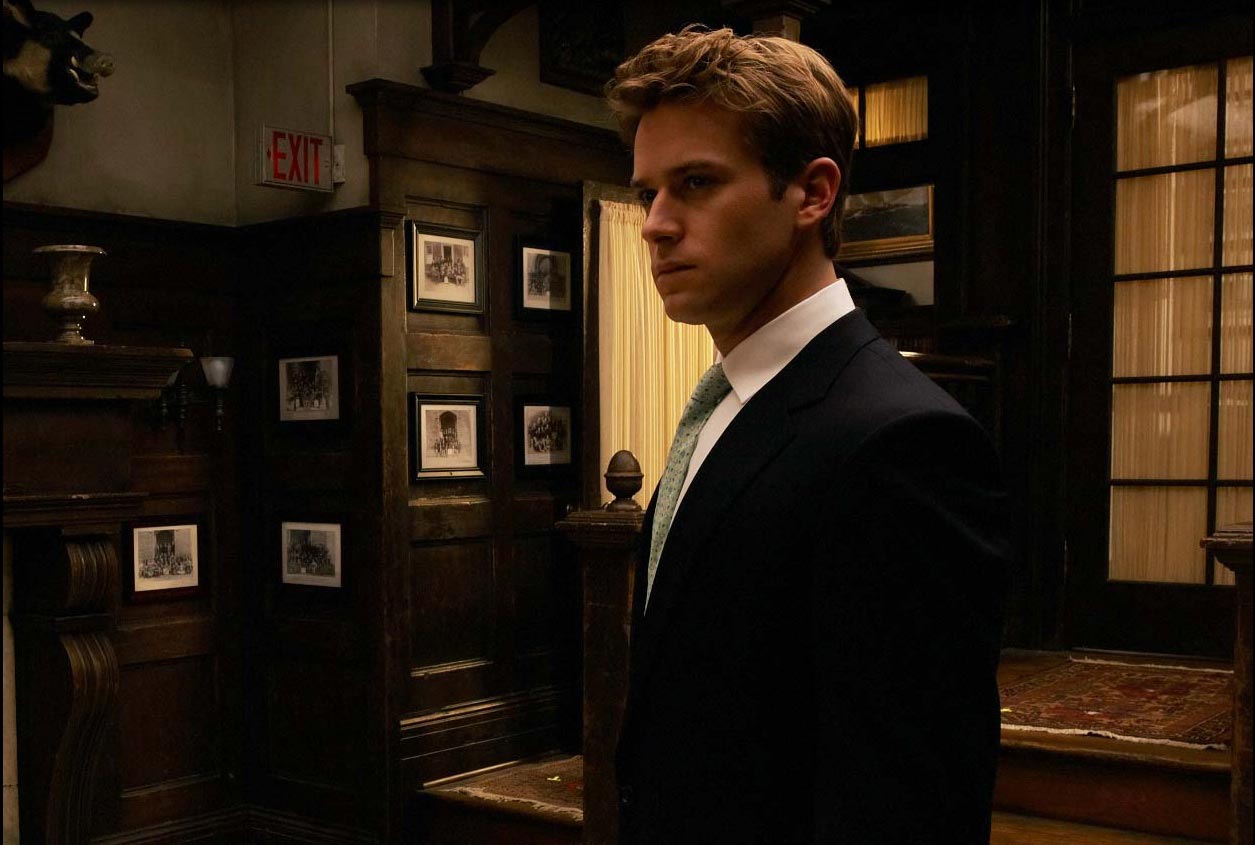
Though I was initially quite skeptical at the thought of a Facebook movie, fearing fad-for-fad’s-sake vapidity, this script is a more-than-pleasant surprise: rather than merely chronicle or moralize, it explores the roots of our modern tendency to “live on the internet,” while also managing, against all odds, to engage us in the success of a revenging misanthrope. Sorkin’s dialogue whips and cuts brilliantly, slicing moment to moment, scene to scene, keeping his characters always two steps ahead of the audience (and, often, of each other); even at 162 pages, it has a jittery, breakneck pace—one that mirrors both Facebook’s rocket rise to fame and the immediacy of the internet culture it depicts. The parallels between Mark’s female trouble and his professional motivations, between old and new money, between socializing and “friend”ing are cleverly drawn and expertly revealed, making The Social Network both narratively entertaining and worthy of real thought about the ways we choose to connect in the new millennium.


That was what I wrote, caffeine-zapped at sunrise last Tuesday, after attempting to synopsize the script for a film class—what I wrote for the Comment section on my coverage, still a little shaken from reading 162 pages twice in three hours, still itching to read it again. That was what I wrote before even seeing the thing—& this is what I'm writing now:

The Social Network is, simply put, incredible.

You don't have to believe me; honestly, if it were me even a week ago, I would have laughed in the face of a statement like that. (Of course, at that point, I was unaware of the writer/director team responsible, but still:) In order to understand the enormity of my transformed opinion, you have to understand just how disdainful I was of this Facebook movie: how my hyperbole gland flared to the size of Montana, & I could be heard deriding from every street corner the apocalyptic, incestuous stupidity of a movie about a social network—let alone the presumption of that definite article! As Facebook slowly chomps away at every plugged-in member (yours truly included)'s last shreds of privacy, gaining truly ludicrous amounts of recognition from ad after ad, worming its way into everyday parlance (verbing nouns, truncating syllables left & right), I can only cringe & self-loathe & wring my hands—&, one would think, cast some serious hate at any movie that promises to glorify it.

But I won't—because it doesn't. Instead, The Social Network is a sympathetic if ultimately scathing look at modern communication—& the gentlemen believed responsible. Chief among them, of course, is Mark Zuckerberg—who is apparently fictionalized beyond recognition by Sorkin's script & Eisenberg's pseudo-Aspergian performance, but ultimately, the facts are irrelevant to its success: this Mark is a nuanced & delicate portrait of exactly the kind of socially inept brainiac who has been getting the short end of Hollywood's stick since The Breakfast Club—who, as the script notes on its first page, harbors "a dangerous & complicated anger."

In the first scene of the film (which is, in fact, so well-written it hurts), Zuckerberg is unceremoniously dumped by his girlfriend, Erica, & channels his bruised pride into a series of nasty Blog posts—& a prototype of Facebook: a website that lets Harvard students rank their female classmates' relative hotness. It's a small taste of the revenge (against Erica, against women) our protagonist is capable of—& will enact, but quick, against Cameron & Tyler Winklevoss, the twin crew captains who claim Mark stole their site idea, & even against his best friend Eduardo—ever bending his hurt into the wrong response. It's an excellent set-up, & Sorkin doesn't disappoint, deploying his various players expertly: Mark makes for an enthralling antihero, Eduardo an equally compelling partner—& the Winklevi (as Mark snidely dubs them) are really, really attractive.

More, even, than plot intrigue: this story proves perfect for chronicling our headlong plummet into the Internet Age—a shift from the rule of blonde Adonises like the Winklevoss twins, with their fancy final club & family connections, to the rise of the innovative programming geek. Age-old systems collapse under the strain of instant global communication: you may have Adidas glued to your feet & be practically incapable of eye contact, but if your ideas are worthy, you will best the blandly bright Olympic athletes. It's a complex & multi-layered movie, pinging from lawsuits to flashbacks with all the speed of a well-oiled modem—but behind it all, there is the simple, emotional truth of love, & the lack of it, & how hard that can sting.

While that much at least clawed its way off the page & into my brainstem last Tuesday, it's an entirely different experience to see it played out onscreen in Fincher's rich & shadowed gloom—colors muted, characters separated (literally, metaphorically) by glass walls. Sorkin's ideas still shine, polished in the razor sharp dialogue, but to hear them spoken lightning-quick by cracking voices, to see the plaintive confusion behind the actors' eyes as they stumble gracefully through this tale of success & betrayal—it's wonderful, to say the least. Lest I slip too far into hyperbole, I'll stay simple: there is something uniquely tragic about an empire founded on unrequited love—a social network sparked by social dysfunction.

The story of an outcast unwilling to confront the romance he craves is nothing new to Fincher, but while Fight Club's nameless narrator at least gets his girl as the buildings crumble, Zuckerberg isn't so lucky: he's torn the world apart—reconfigured irreparably the way teenagers interact, all to impress his former lady—but by doing so, he's made it impossible to really reconnect with her. Ultimately, the film's cheesy tagline—You don't get to 500 million friends without making a few enemies...—is just an over-hyped version of its subtler poignant message, the painful irony highlighted so damn beautifully in its last, heart-rending moments: that though there's a semblance of communication in Social Networking, it's all empty performance—a public display of Popularity & Closeness, made alone, isolated, staring blankly into fluorescent light.


Today's Headphone Fodder:

Yes, I'm staying on topic today—picking that same song expertly chopped up in the Social Network trailer, above. As I've stated previously, I have a deep & personal (if slightly mortifying) connection to the song "Creep"—one that involved me listening to it on repeat as I fell asleep, every night for a decent several-month stretch in 7th grade. Though I now recognize the emo of my ways, there's still something unheeded that stirs in me when I hear this song, whether Amanda Palmer's stripped ukulele version, Paolo Nutini's raspy warble, or even the original. This version is particularly sharp, though—epic, even; something about that soprano bridge, the minor harmonies of angels fallen. &, even if you don't share my secret passion for this song, you can at least enjoy hundreds of little Belgian girls earnestly crooning the word "fucking." Three times. (You're welcome.)

Wednesday, June 9, 2010

Anneliese Watches Wolfman; Proclaims, "Darling, This Is No Joke..."


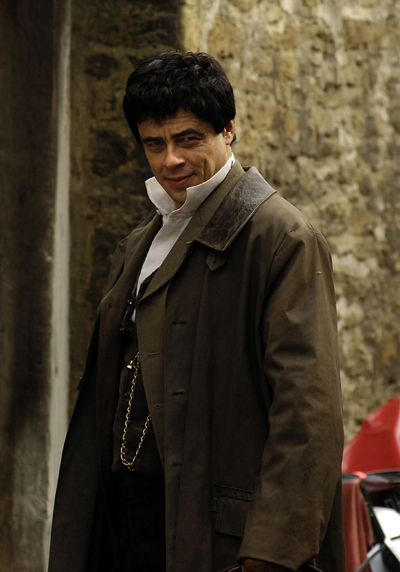
I first saw The Wolfman advertised in the space above my local subway entrance—where it stayed, for several months (before losing out to a Spanish language ad for a dating service), which means I was reminded of the impending film almost every day for a good while. In that time, I was able to hype myself up pretty sufficiently for a Monster Movie starring Benicio del Toro, Anthony Hopkins, & (especially) Hugo Weaving—a movie whose trailer promised the same Medical Mystery Period Piece feel as The Elephant Man, but with far more gut-ripping & gore.


Though the film quickly sank without a trace (it merits a measley 33% on Rotten Tomatoes), my brother & I managed to stumble upon it while hunting for a movie to snark at on a Tuesday night; I convinced him to give it a go, at least for curiosity's sake. After just under two hours spent repeatedly fighting off sleep, I reluctantly arose with a lurch of annoyance & some unanswered questions:

1) When exactly did Benicio del Toro get so unattractive? (Seriously, though: ouch.)

2) Why was he in this movie at all, as he ended up being the only person in England with an American accent? (&, moreover, as he got his ass handed to him performance-wise by Hugo Weaving—which was particularly funny because his character was supposed to be a renowned Shakespearean actor.)

3) Why, when the credits began to roll, did I see names like Danny Elfman—who has a hand in everything I love, from Oingo Boingo to singing for Jack Skellington to the instrumentals in Chicago—& Andrew Kevin Walker, writer of Se7en & serious, though uncredited, contributor to Fight Club (see: Detectives Andrew, Kevin, & Walker)??????

Rather than rejoice in recognizing former heroes, I felt betrayed, bewildered: how, in the name of all that is hol(l)y(wood), could these people have made such an oozing, putrid eyesore of a movie? No, seriously. How?! I am still baffled. Not only was the plot lagging, there was no plot; not one character merited an ounce of sympathy, nor had anything resembling a personality; there wasn't nearly enough campy, call-back material to attribute its shitty effects & gross-out gore to homage—all-in-all, just one of those dumbfoundingly dreadful movies that, though they look expensive & ought to be a good time, are actually physically unpleasant to watch. (The Black Dahlia, anyone?)

Mainly, though, I'm upset that there was no second layer to this concept—quite literally nothing beyond "ZOMG HE TURNS INTO A WOLF, GUYZ," on any level. While Christopher Nolan spent the better part of two & a half hours hammering the Dark & Deeply Ethical Symbolism of Batman into our heads (& was rightly lauded all the more for it), this movie—which only by its very last line manages to wonder "where [man] ends & [beast] begins" in wispy Victorian—delves not one whit beyond those words into the near-unavoidable metaphors inherent in the werewolf myth. Honestly, failing to make a werewolf metaphorically significant is harder than hitting the apple off William Tell's head—& yet, this movie manages to aim dead center.

But really now: the concept of werewolves has trickled down all the way from the Bible, &/or Ovid's Metamorphoses, both of which contain stories of a greedy, evil king (Nebuchadnezzar &/or Lycaön) cursed by God &/or Zeus to live as a wolf. In the case of Ovid, it's made especially clear that the form of a wolf is far more fitting than that of a man to Lycaön's brutal nature; even from its origins, even before werefolk sprouted fur & went wild only one night a month, it was important—was ingrained—that the werewolf revealed the dark nature of a man. Especially in its modernized idiom, when the gore is confined to a night of particular lunacy & the werewolf necessarily exists as both man & beast, it is, in my mind, wildly irresponsible to make a movie on the subject with no mention of this symbolism: no use of twinning or a "darker half," no emphasis on man's inherent wildness coupled with especially—even sartorially—repressive Victorian England.

There is a reason myths exist—why (for a disappointing dearth of one sentence in two hours) del Toro mentions Jack the Ripper. A man who uncontrollably morphs into a bloodthirsty wolf—much like the good doctor whose violent alter ego breaks out of the shadows—represents the literalizing of a very human fear: that Something Wicked lurks inside us & that somehow, the beast will out, flying our dirty secrets & unacceptable desires for all to see. I've previously explored the more benign aspect of this with Miike Snow's "Animal," but I think the Victorian Era—home to Jack & Jekyll & The Elephant Man himself—deserves a more extreme take.

As science reigned post-1850, asylums were seriously reformed: the notion that mental illness was a "disease of the soul" became passé, & doctors opted for scientific study of patients in lieu of neglect & feral treatment. Once something leaves appropriate public perception, though, it's doomed to be hashed & rehashed by pulp writers, leaking into urban myth & individual conscience; the widespread notion that mental illness can be scientifically explained only begs the question—in great, looming Scooby-Doo letters—But What If It Can't? For example, in this film's perhaps one decent scene, a doctor offers our protagonist a traditional psychiatric diagnosis of Lycanthropy (i.e., del Toro's character hates his father so much he has monsterized him, & himself by extension)—while the patient denies it, pleads for death, & ultimately literally lycanthrop-ifies behind him, soon skewering said doctor on a fence several stories below. In a society obsessed with mental illness—whose streets were haunted by slaughtered prostitutes, whose hospitals held a man deformed beyond the point of recognition—it follows that the chief villain to arise would be a man entirely out of control of his own humanity, a lawless creature slaked only with bloodlust & moonlight.

All of that said—& I do love to say it—the movie evokes none of this. Rather, it's a long collection of cheesy special effects & pointless non-twists, empty lines acted emptily with no sense of build-up or direction—& moreover, the actual werewolf, post-transformation, is laughably stupid-looking. There is, quite literally, nothing to get behind in this movie—except, perhaps, a rousing chorus of "Werewolves of London" with friends during the straight-from-a-videogame urban chase scene. Really, though: it's stunningly lifeless in every possible way.

However, this trainwreck of trainwrecks may ultimately not have been the fault of my main men behind the camera; as (my favorite) independent online film critic Dustin Putman explains in his review:
As so often seems to happen with big-budget, studio-bred Hollywood moviemaking, too many cooks in the kitchen have ruined what probably once started with the purest of intentions. Before several directors were shuffled in and out, multiple crew members quit, reshoots took place, release dates were scheduled and canceled, the composer was replaced before getting invited back at the last minute, and a war over final cut was waged, "The Wolfman" was intended as a loving tribute to the classic Universal monster movies of the 1930s and '40s, most notably 1941's original "The Wolf Man" starring Lon Chaney. As a loose remake, this update sports a prestigious cast and the kind of production design, art direction, cinematography, and costuming every bit as sumptuous as an $85-million budget can buy. What it lacks is not only a beating heart, but a beating anything.
Thank you, Dustin. As usual, you speak the truth.

[ My actual copy of Ovid's Metamorphoses. Clearly putting that education to good use, yessiree. ]

Today's Headphone Fodder:


I've been meaning to check out Placebo for a few years now, having known them only as That Band That Does a Kickass Cover of 20 Century Boy in Velvet Goldmine—& I finally did! Hooray for follow-through!

The results, while not so excellent as I would have originally thought, are still perfectly positive. I'm surprised at how... well... Emo they are: Post-Smashing Pumpkins Nasal-itude, Black Clothes & Nails, 30 Seconds to Mars-esque (But With Actual Musical Ability). The worst of it tends towards the recent, though; the first few albums (Placebo, Without You I'm Nothing, Black Market Music) have some gems, including Nancy Boy, which is deliciously coy & biting & all; Pure Morning , which is so catchy it ought to be banned in the 48 states at least; Special K , which is about exactly what you think (unless you're thinking of the breakfast cereal); Commercial for Levi , the lullaby-gone-wrong, which is short & sickly sweet in a perfect sort of way.

Aside from these few, though, my favorite of Placebo—so far, at least—is in the covers: the afore-linked T. Rex homage; androgynously gorgeous frontman Brian Molko's cover of Bowie's Five Years ; & this surprisingly moving (or is that really just me?), sonically-fleshed live version of the Pixies' Where Is My Mind , featuring an aged Frank Black. As Molko himself rhetorically closes: "Mais quelle dernière chanson, eh?"

EDIT: OH MY GOD YES PLEASE. (If you're not convinced right away, just wait around until after the first chorus. Brian Molko makes a really fucking excellent post-90s Morrissey-reinterpreter.)

Thursday, June 3, 2010

Why Action Movies Are Awesome. (No, Seriously.) Written By a Female Film Snob.

[ NOTE: Though I couldn't think of a more fitting—& snappy—phrase than "film snob," despite the fact that I consider myself more of a film enthusiast/obsessee, what I was essentially trying to convey with that title is this: I am the least likely demographic of person to ever love action movies. But I do. So listen up. ]


Walter Benjamin chose to end his essay, "The Work of Art in the Age of Mechanical Reproduction"—in which he discusses at length the effects of film on man & society—with a passage from the Futurist Manifesto of Filippo Marinetti:

War is beautiful because it initiates the dreamt-of metalization of the human body. War is beautiful because it enriches a flowering meadow with the fiery orchids of machine guns. War is beautiful because it combines the gunfire, the cannonades, the cease-fire, the scents, and the stench of putrefaction into a symphony.
To which he chides:

[Mankind's] self-alienation has reached such a degree that it can experience its own destruction as an aesthetic pleasure of the first order.
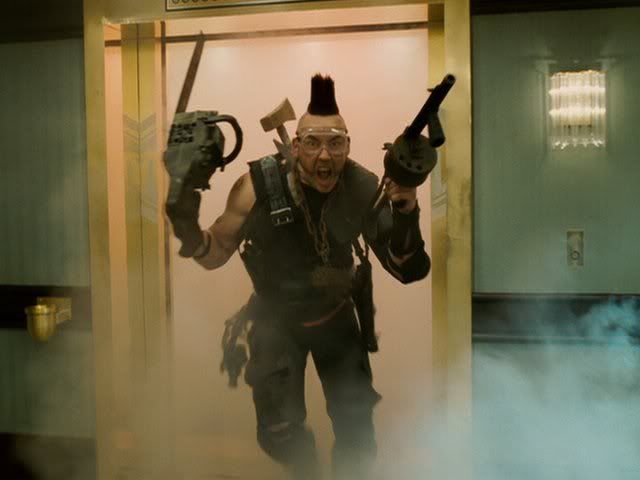
It goes without saying that Benjamin would have shit his britches were he permitted to view the blood-drenched splendor that is the climactic battle of Smokin' Aces, in which five sets of hired hitmen go head-to-head over one mob target. Because if there is one place in which this movie doesn't fail, it's this: the utter aestheticizing of capital-V-Violence. Dialogue may fall flat, the plot halts & capsizes at each turn like a poorly oiled shopping cart—but the saturated super-blue of Kevin Durand's eyes, pleading amid a sparkle of flying glass, as he falls back onto a chainsaw & blood like Crayola ink splatters skyward in a demented fountain... It's really something to see.

& I mean that. Because a well-made action movie is, on some level, what going to the movies is all about. Of course, so are the syrup-slow neoneorealist indie somnambles, but a good part of film's original intent—the Voyage dans la lune, Méliès-style spectacle—is in a wham-bam-thank-you-ma'am, you-will-never-see-this-elsewhere shock-fest, carpet-bombed with effects & begging you to let it go further. When presented in the right light, a shoot-out can achieve Depth, a gangfight becomes High Art—but when handled with talent, zeal, a little humor, & an iron clad pair of Balls (the figurative, unisex kind), action movies transcend the need for these capitalized, capitalizing arthouse ghouls & just become pure fucking gorgeous fun.

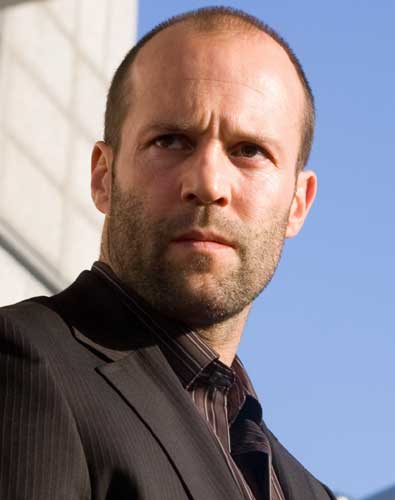
Crank is a perfect example of this. For those unfamiliar: the basic conceit of Crank is that (age-old, brick-faced) Jason Statham has been injected with "some Chinese shit" that will kill him in a matter of minutes—unless he can keep his heart rate at a constant, adrenaline-fueled skyrocket. Basically, it's like Speed meets The Magic Schoolbus: Inside Ralphie—which, as you might imagine, makes for one hellish ride. Take this sequence, in which Statham holds up a hospital, main-lines pure epinephrine, then surfs crucifixion-style on a stolen police motorcycle. (Note Dennis Reynolds pushing the cart—&, later in the film, the little boy from A Simple Wish credited as "Warehouse Hood Leader.")

I mean, what's not to love? Really, though—the rhythm of shots is exciting; camerawork gripping; the use of super-saturated color only adds to the feeling that what we are seeing now is too much. Use of videogame references & news footage throughout the remaining 80 minutes remind us how hyperviolence already seeps into our everyday; Crank intentionally renders itself ridiculous, calls out its own parodying. This self-referential nod from both style & premise—as well as the masterful editing, the pervasive humor—make this, in my opinion, a film among films.

& so, too, with Smokin' Aces. While not so clever all-around like Crank, it really is incredibly, almost unfathomably well-made; despite its ludicrous & fumbling plot, it is, when all is said & done, an especially aesthetically pleasing film. Consider its trailer (which is, I can assure you, a microcosm of the full film's processes). [Unfortunately, the embeddable version is terrible quality—& not the one I want to show.]

First of all, we'll just say that Michael Bluth owns a piece of my heart & get that out of the way. (His part in this movie is painfully, painfully small, despite how it's made to look.) Most importantly, though: the images are color-conscious, saturated & well-framed; the editing is choppy & brisk, exciting even when there's little to be excited about (Ben Affleck? Really?); & it has that crucial dose of humor. Given, it's a shot of a man Sharpie-ing on a Hitler mustache set to elevator music—but those ice-blue irises against a flare of ochre sun...!

My point is simply this: that anything can be rendered beautiful if handled right. Take, for example, the shootout in John Woo's criminally over-the-top Face/Off, in which a little boy is given noise-cancelling headphones, & we are then allowed to watch the scene from his point of view, as "Somewhere Over the Rainbow" drowns out the sounds of violence:


Bodies flip & fall amid the sparks in a drunken ballet; mouths wide in pain seem cartoonish, representative—until they don't, & the urgent tubas butt back in, bringing gunfire & panic, & we realize what we were supposed to hear all along. By decontextualizing the violence to such a degree—rendering it purely aesthetic, purely beautiful, if perversely so—before yanking us back to our actual understanding of a gunfight—which is fierce & frightening—Woo is (among other things) reminding us of Benjamin's admonishment, that we experience our own destruction as pleasure.

But is this really such a bad thing? I would say: only if violent movies incite violent acts. Some say they do, some say they don't. I, personally, have no desire to own a gun, let alone fire it while getting head & speeding down a highway—but I sure love watching Jason Statham pretend to. (I also understand that my brain functions differently than that of a soda-fueled twelve year old boy—but that is, I think, more of an argument for keeping them away from these films than for keeping these films from being made.) Then, is there really harm in depicting violence beautifully, as long as that violence remains in diegesis?

I say, no. I say, bring it on. Though Marinetti's futurist manifesto provokes too far (obviously, murder as art is not something anyone should ever condone), it does represent the misguided literalizing of what I consider to be a valid point. Because the magic of film lies in the presentation of life as we can't see it—slowed down, sped up, to zoomed in close, as the director guides our eye—& violence is as much a part of life as friendship or sex. Moreover, film presents such possibility for making the unreal real, that it seems almost obligated (at least sometimes) to present life as we really can't see it, with special effects & wild, impossible scenarios.

In my mind, as long as an improbable last-second reunion of star-cross'd lovers is acceptable cinema, then so is a guns-blazing final showdown. In fact, the former is simpler to create (& to experience), because love is emotionally pleasurable; to render violence beautiful, so much so that it divorces from its inherent ugliness, is true craftsmanship at work. Well-made film is well-made film—but more than that, I would assert that a well-made violent film is often an inherently better film than most: All Quiet on the Western Front is an emotionally-paralyzing antiwar juggernaut, a truly transcendent piece of cinema—in part, of course, because the shells flashing white-hot across a wasteland of gunsmoke, even as they fell a blinded soldier, are beautiful.

I feel it's important to clarify, however:

1) that real, worthwhile Action Movies are a small, small subset of the drivel that normally gets shoved into that category. See: Smokin' Aces 2: Assassins' Ball. (I haven't.)

2) that I don't see Evoking the Sadness of Death as crucial to a violent movie's success.

Rather, the moment I really fall off the Smokin' Aces bandwagon is when, around the hour-or-so mark, they start to (over)dramatize the toll that certain deaths take on the bloodied-but-living: there are many tears, vengeful clip-emptyings, surges of mournful scoring. Meanwhile, inconsequential characters (or, those revenged upon) continue to drop like jostled mannequins: they try to have & eat their cake in such tactless, sloppy bites that the movie loses all its vitality, stops being my platonic Action Movie, & flails emptily in unearned Sentiment. The violence is neither interesting, nor is it successfully emotional, slipping off both sides of the tightrope in a spectacular bellyflop. Were it either—or, were it both, as [MAJOR SPOILER from The Departed] only the best manage—it would continue to be impressive, but instead, it's just impressively disappointing.

However, I'm talking here about the very end of Smokin' Aces. I really do enjoy its first two-thirds—which is, of course, what I feel the need to justify, constantly, here & in conversation, because there is inherent disrespect for a movie that's marketed under the gun-full umbrella of Action. But really now, after paragraph upon paragraph, I ask you again: if a movie is both beautiful & exciting, enthralling to eye & adrenal gland (& yes, occasionally, heart) because it is just so damn skillfully put together—what's not to love?

Well, one thing, at least (she says, guiltily shoe-gazing). Though my main thrust in this musing has been to dissect the depiction of violence in my beloved Action Movie, it's impossible to talk about these films without mentioning their near-unbroken trend of serious female exploitation, which is ultimately unjustifiable.

& I tried. Really, I did. I wrote a whole paragraph about how everything is so heightened that the men aren't realistic either, but then I just sounded like those people who try to justify female superhero costumes—showing large swaths of skin, clinging to gigantic breasts that loom above impossibly thin waists—by saying that the men are just as exaggerated. But there is, of course, a crucial difference, in that they're exaggerated with separate ends in mind: men are super-powerful, & though women may be too, they must also be super-sexy. In short: supermen don't have comically large crotch-bulges—just as male action heroes are badasses first, attractive later. Balding, blunt-featured Jason Statham is not a heartthrob by any stretch, but after watching him perform some derring-do, he becomes potentially desirable in the most cavemanesque sense—in that, if it came to it, he could probably keep you in furs & deer carcass, fell the occasional wooly mammoth, etc.

Meanwhile, women in action movies are trophies, set decoration, or damsels in distress—with the occasional intervention of an oversexed female superheroine, who is, in her own way, almost worse (Ooh! A woman kicking ass? What a lark! It's a wonder her half-inch of spandex underwear hasn't ridden up...). There are exceptions, of course, but they pale in comparison to the exploited masses, & that's a fact.

So here's the deal: I think more action-loving Ladies need to come out of the woodwork. If we make it clear that beer-bellied testosterone dispensers (& their younger counterparts) aren't the Action Movie's only enthused patrons, then maybe we can stem the tide of tits-for-tits'-sake & Token Girls. Though it's the pill we have to swallow for now to enjoy some really, truly excellent films (I know, I know, it pains me, too—really), maybe, someday, things will be different...

This is, of course, essentially a fantasy, & I recognize it as such, but it's the only way I can reconcile this really icky trend in the movies I love—the little suspension of disbelief I allow myself, even before sitting back to watch something truly spectacular.

Today's Headphone Fodder:


World Destruction—Time Zone feat. Afrika Bambaataa & John Lydon.

It's just brilliant. I mean, really. The two unlikeliest anti-norm forces—an afrocentric hip-hop group & the cockeyed, safety-pinned onetime Rotten—colliding to denounce the frustrating lunacy of a Moral Majority—&, especially, its leader. There's not much more to say, other than that in a time of Armageddon scares—oil spills & chokeholds of ignorance, Glenn Beck leading a swarm of his own chanting reactionary lunatics—it's somewhat comforting to know that people have felt this way before, enough to merge hyperAfrican hip hop & borderline skinhead Britpunk. They felt this way, & yet—Reagan's blundering prophecies aside—we're all still here. Of course, that could just mean we're due.