[ Apologies, dear Reader, for these lengthy posting gaps. The school, it exhausts; the weekends, they overflow. Anyhow, here's a little something I've compiled, if hastily. Meanwhile, if you have any advice on how to best write five pages about Heidegger's Introduction to Metaphysics, please, give me a call... ]
Though I was initially quite skeptical at the thought of a Facebook movie, fearing fad-for-fad’s-sake vapidity, this script is a more-than-pleasant surprise: rather than merely chronicle or moralize, it explores the roots of our modern tendency to “live on the internet,” while also managing, against all odds, to engage us in the success of a revenging misanthrope. Sorkin’s dialogue whips and cuts brilliantly, slicing moment to moment, scene to scene, keeping his characters always two steps ahead of the audience (and, often, of each other); even at 162 pages, it has a jittery, breakneck pace—one that mirrors both Facebook’s rocket rise to fame and the immediacy of the internet culture it depicts. The parallels between Mark’s female trouble and his professional motivations, between old and new money, between socializing and “friend”ing are cleverly drawn and expertly revealed, making The Social Network both narratively entertaining and worthy of real thought about the ways we choose to connect in the new millennium.
That was what I wrote, caffeine-zapped at sunrise last Tuesday, after attempting to synopsize the script for a film class—what I wrote for the Comment section on my coverage, still a little shaken from reading 162 pages twice in three hours, still itching to read it again. That was what I wrote before even seeing the thing—& this is what I'm writing now:
The Social Network is, simply put, incredible.
You don't have to believe me; honestly, if it were me even a week ago, I would have laughed in the face of a statement like that. (Of course, at that point, I was unaware of the writer/director team responsible, but still:) In order to understand the enormity of my transformed opinion, you have to understand just how disdainful I was of this Facebook movie: how my hyperbole gland flared to the size of Montana, & I could be heard deriding from every street corner the apocalyptic, incestuous stupidity of a movie about a social network—let alone the presumption of that definite article! As Facebook slowly chomps away at every plugged-in member (yours truly included)'s last shreds of privacy, gaining truly ludicrous amounts of recognition from ad after ad, worming its way into everyday parlance (verbing nouns, truncating syllables left & right), I can only cringe & self-loathe & wring my hands—&, one would think, cast some serious hate at any movie that promises to glorify it.
But I won't—because it doesn't. Instead, The Social Network is a sympathetic if ultimately scathing look at modern communication—& the gentlemen believed responsible. Chief among them, of course, is Mark Zuckerberg—who is apparently fictionalized beyond recognition by Sorkin's script & Eisenberg's pseudo-Aspergian performance, but ultimately, the facts are irrelevant to its success: this Mark is a nuanced & delicate portrait of exactly the kind of socially inept brainiac who has been getting the short end of Hollywood's stick since The Breakfast Club—who, as the script notes on its first page, harbors "a dangerous & complicated anger."
In the first scene of the film (which is, in fact, so well-written it hurts), Zuckerberg is unceremoniously dumped by his girlfriend, Erica, & channels his bruised pride into a series of nasty Blog posts—& a prototype of Facebook: a website that lets Harvard students rank their female classmates' relative hotness. It's a small taste of the revenge (against Erica, against women) our protagonist is capable of—& will enact, but quick, against Cameron & Tyler Winklevoss, the twin crew captains who claim Mark stole their site idea, & even against his best friend Eduardo—ever bending his hurt into the wrong response. It's an excellent set-up, & Sorkin doesn't disappoint, deploying his various players expertly: Mark makes for an enthralling antihero, Eduardo an equally compelling partner—& the Winklevi (as Mark snidely dubs them) are really, really attractive.
More, even, than plot intrigue: this story proves perfect for chronicling our headlong plummet into the Internet Age—a shift from the rule of blonde Adonises like the Winklevoss twins, with their fancy final club & family connections, to the rise of the innovative programming geek. Age-old systems collapse under the strain of instant global communication: you may have Adidas glued to your feet & be practically incapable of eye contact, but if your ideas are worthy, you will best the blandly bright Olympic athletes. It's a complex & multi-layered movie, pinging from lawsuits to flashbacks with all the speed of a well-oiled modem—but behind it all, there is the simple, emotional truth of love, & the lack of it, & how hard that can sting.
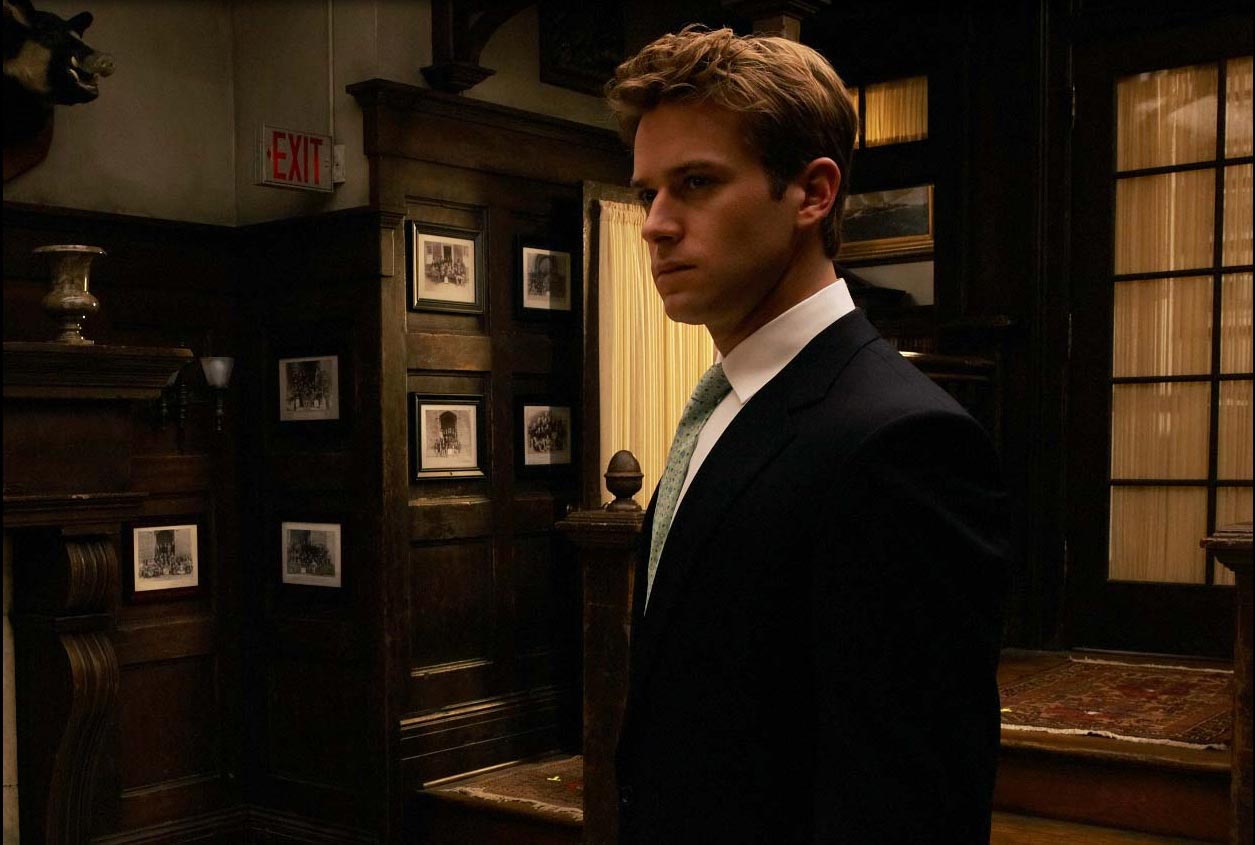
While that much at least clawed its way off the page & into my brainstem last Tuesday, it's an entirely different experience to see it played out onscreen in Fincher's rich & shadowed gloom—colors muted, characters separated (literally, metaphorically) by glass walls. Sorkin's ideas still shine, polished in the razor sharp dialogue, but to hear them spoken lightning-quick by cracking voices, to see the plaintive confusion behind the actors' eyes as they stumble gracefully through this tale of success & betrayal—it's wonderful, to say the least. Lest I slip too far into hyperbole, I'll stay simple: there is something uniquely tragic about an empire founded on unrequited love—a social network sparked by social dysfunction.
The story of an outcast unwilling to confront the romance he craves is nothing new to Fincher, but while Fight Club's nameless narrator at least gets his girl as the buildings crumble, Zuckerberg isn't so lucky: he's torn the world apart—reconfigured irreparably the way teenagers interact, all to impress his former lady—but by doing so, he's made it impossible to really reconnect with her. Ultimately, the film's cheesy tagline—You don't get to 500 million friends without making a few enemies...—is just an over-hyped version of its subtler poignant message, the painful irony highlighted so damn beautifully in its last, heart-rending moments: that though there's a semblance of communication in Social Networking, it's all empty performance—a public display of Popularity & Closeness, made alone, isolated, staring blankly into fluorescent light.
Today's Headphone Fodder:
Yes, I'm staying on topic today—picking that same song expertly chopped up in the Social Network trailer, above. As I've stated previously, I have a deep & personal (if slightly mortifying) connection to the song "Creep"—one that involved me listening to it on repeat as I fell asleep, every night for a decent several-month stretch in 7th grade. Though I now recognize the emo of my ways, there's still something unheeded that stirs in me when I hear this song, whether Amanda Palmer's stripped ukulele version, Paolo Nutini's raspy warble, or even the original. This version is particularly sharp, though—epic, even; something about that soprano bridge, the minor harmonies of angels fallen. &, even if you don't share my secret passion for this song, you can at least enjoy hundreds of little Belgian girls earnestly crooning the word "fucking." Three times. (You're welcome.)